
Evidence-Based Learning Strategy Analyzer
Select the methods you currently use:
Identifying my "VAK Style"
Taking quizzes to label myself as Visual/Auditory/Kinesthetic.
Passive Re-reading
Reading notes or textbooks over and over until they feel familiar.
Cramming
Studying in one long block right before a test or deadline.
Multitasking
Checking notifications or doing other tasks while learning.
Active Recall
Testing yourself from memory without looking at notes.
Spaced Repetition
Reviewing material at increasing intervals over time.
Teaching It Back
Explaining concepts to others (or a rubber duck).
Elaboration
Connecting new info to prior knowledge/experience.
Interleaving
Mixing different related topics in one session.
Effectiveness Score
Select Methods
Click the cards above to see how your strategies stack up against science.
Why These Strategies Work
- Cognitive Load Theory: Minimizing distractions and using multimodal inputs keeps working memory from getting overwhelmed.
- Desirable Difficulty: Techniques like Active Recall force the brain to work harder to retrieve info, which strengthens neural pathways.
- Andragogy: Adults learn best when connecting new skills to their vast library of existing experience (Elaboration).
Walk into almost any corporate training room or adult education workshop, and you will likely see a handout asking participants to identify their "learning style." Are you a visual learner? Do you need to hear things explained (auditory)? Or do you have to get your hands dirty to understand (kinesthetic)? For decades, this framework-known as the VAK model (Visual, Auditory, Kinesthetic)-has been the gold standard for understanding how people absorb information. It feels intuitive. It feels personal. But here is the uncomfortable truth: there is no scientific evidence that matching instruction to a specific learning style improves outcomes.
In fact, the idea that adults have one dominant, fixed way of learning is largely considered a myth by cognitive scientists and educational psychologists today. So, if we strip away the popular psychology, what actually happens when adults try to learn new skills? The answer isn't about forcing yourself into a box labeled "visual" or "auditory." It is about how the human brain processes complex information under pressure, fatigue, and real-world constraints.
The Myth of the Dominant Style
To understand why the search for a "most common" style is flawed, we first have to look at where the idea came from. In the 1970s and 80s, educators like Neil Fleming developed the VAK model to help teachers vary their methods. The goal was never to pigeonhole students but to encourage diverse teaching techniques. Somewhere along the line, however, the advice shifted from "teachers should use multiple methods" to "students must be taught only in their preferred style."
This shift created the "meshing hypothesis": the idea that a visual learner learns better through diagrams than text, while an auditory learner thrives on lectures. Decades of rigorous testing have failed to support this. A landmark review by Pashler et al. (2008) examined dozens of studies looking for evidence that tailoring instruction to learning styles improved academic performance. They found virtually none. When researchers controlled for other variables, the "style" made no difference in test scores or retention rates.
So, why does it feel so true? If you prefer watching a YouTube tutorial over reading a manual, you might think you are a "visual learner." But you aren't necessarily processing information differently; you just find visuals more engaging or less effortful in that moment. Preference is not the same as ability. Confusing the two leads to wasted time trying to force square pegs into round holes.
How Adults Actually Learn: Cognitive Load Theory
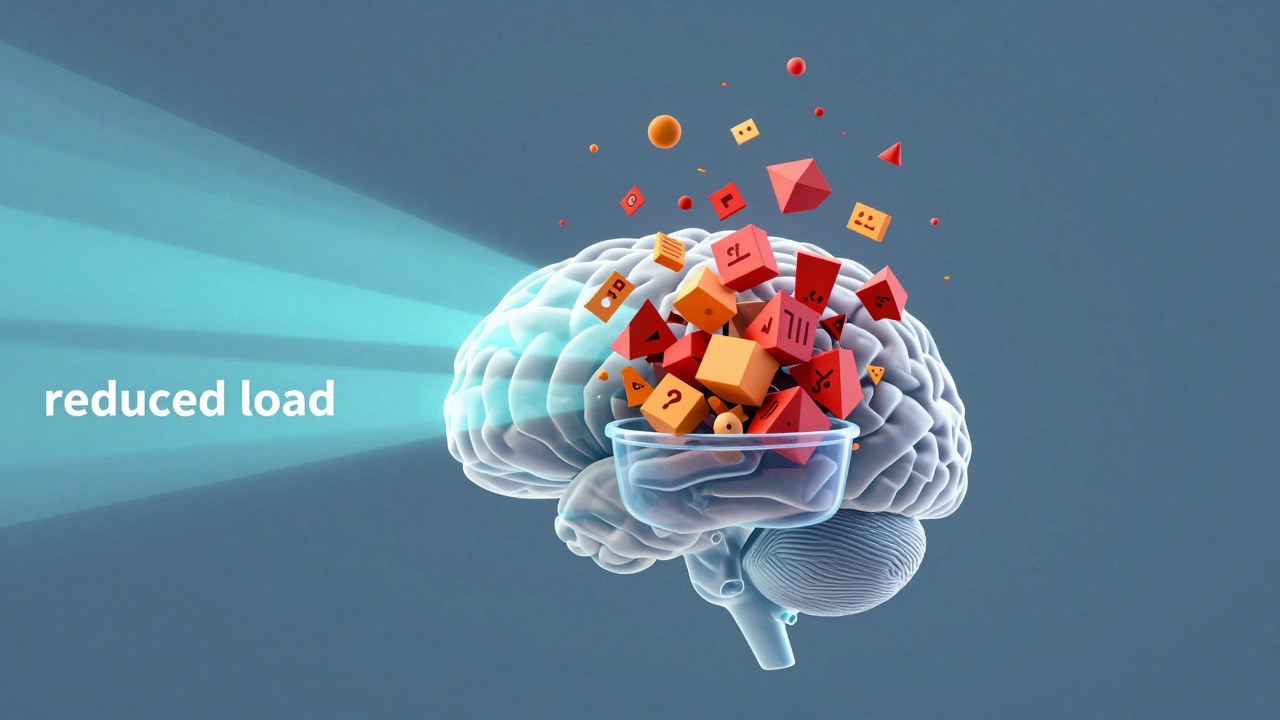
If learning styles don't dictate our success, what does? The most robust framework for understanding adult cognition is Cognitive Load Theory (A theory developed by John Sweller explaining how working memory limits affect learning). This theory suggests that our brains have a limited "working memory" capacity. When we try to learn something new, we are juggling existing knowledge with incoming data. If the load becomes too heavy, learning stops.
Adults face unique challenges here. Unlike children, who often learn in structured environments with fewer distractions, adults are managing jobs, families, and financial stress. Their cognitive bandwidth is already taxed. Therefore, the "best" way for an adult to learn is not defined by a sensory preference, but by reducing extraneous cognitive load.
Consider learning a new software program. A purely textual manual creates high cognitive load because you must visualize the interface while decoding the instructions. A pure video lecture creates load if you have to pause and rewind constantly. The most effective approach combines both: a split-screen view showing the action alongside concise steps. This isn't because you are a "visual-auditory hybrid." It is because this method aligns with how the brain naturally integrates dual channels of information without overwhelming working memory.
The Role of Prior Knowledge and Experience
One major factor that distinguishes adult learning from child learning is prior experience. Adults bring a wealth of background knowledge to the table. This is known as Andragogy (The method and practice of teaching adult learners, developed by Malcolm Knowles). According to Andragogical principles, adults are self-directed and problem-centered rather than content-oriented.
When an adult learns a new skill, they immediately map it against what they already know. If you are a carpenter learning to code, you might understand "loops" by comparing them to repetitive physical tasks. Your "learning style" is irrelevant compared to your schema-the mental structures you use to organize information.
This means the most effective learning strategy for adults is elaboration. Instead of passively consuming information, adults learn best when they actively connect new concepts to existing experiences. Ask questions like: "How does this relate to my current job?" or "Where have I seen this pattern before?" This active retrieval strengthens neural pathways far more effectively than choosing between a podcast or a diagram.
Context Matters More Than Modality
Another critical insight from modern educational psychology is that the nature of the material dictates the best learning method, not the learner's personality. You cannot learn geometry effectively through audio alone. You cannot learn a foreign language's pronunciation through text alone. The content itself demands specific modalities.
Research shows that multimodal learning-using text, images, and interaction together-is superior for almost everyone, regardless of any supposed preference. This is supported by Mayer’s Principles of Multimedia Learning, which demonstrate that people learn better from words and pictures than from words alone. However, this benefit applies universally. It doesn't mean visual learners benefit *more* than auditory learners; it means *all* humans benefit from well-designed multimedia.
For adults, context also includes emotional state and environment. Stress inhibits the prefrontal cortex, the area responsible for higher-order thinking. An adult trying to learn a complex financial concept after a stressful day at work will struggle, regardless of whether the material is presented as a chart or a speech. Creating a low-stress, focused environment is often more impactful than tweaking the presentation format.
Practical Strategies for Adult Learners
Since chasing a "dominant style" is a dead end, what should you do instead? Here are evidence-based strategies that work for nearly all adults:
- Use Active Recall: Instead of re-reading notes, close the book and try to recite the key points from memory. This forces your brain to retrieve information, strengthening the memory trace.
- Space Out Your Study: Cramming works for short-term tests but fails for long-term retention. Use spaced repetition systems (like Anki) to review material at increasing intervals.
- Interleave Topics: Rather than blocking eight hours on one subject, mix related topics. This helps your brain distinguish between concepts and apply them flexibly.
- Teach It Back: Explain the concept to someone else (or even a rubber duck). If you can’t simplify it, you don’t fully understand it yet.
- Minimize Distractions: Protect your working memory. Turn off notifications. Single-tasking is not just a productivity hack; it is a biological necessity for deep learning.

Comparison: Learning Styles vs. Evidence-Based Methods
| Approach | Core Idea | Scientific Support | Effectiveness for Adults |
|---|---|---|---|
| Matching Learning Styles (VAK) | Tailor content to visual/auditory/kinesthetic preference | None (Debunked) | Low; may create false confidence |
| Multimodal Instruction | Combine text, graphics, and narration | Strong (Mayer’s Principles) | High; reduces cognitive load |
| Active Recall | Test yourself instead of re-reading | Very Strong | Very High; boosts long-term retention |
| Spaced Repetition | Review material over expanding intervals | Very Strong | Very High; combats forgetting curve |
| Elaborative Interrogation | Ask "why" and connect to prior knowledge | Strong | High; leverages adult experience |
Why the Myth Persists
If the science is clear, why do companies and schools still use learning styles assessments? Partly because it is comforting. It gives learners a sense of identity and control. "I’m not failing; I’m just a kinesthetic learner." It shifts blame from effort or strategy to innate trait. Additionally, the VAK model is easy to sell. Workshops on "identifying your style" are quick to produce and feel personalized, even if they lack empirical backing.
However, relying on these myths can be harmful. It may discourage adults from engaging with difficult material simply because it doesn’t match their "style." A student who identifies as "auditory" might avoid reading dense texts, missing out on crucial vocabulary and nuance. By letting go of the style label, you open yourself up to more versatile and powerful learning techniques.
Conclusion: Focus on Flexibility
There is no single "most common" learning style for adults because the concept itself is scientifically invalid. Instead of searching for a label, focus on the mechanics of learning: reduce cognitive load, leverage prior knowledge, and use active recall. The best learner is not the one who sticks rigidly to a preferred modality, but the one who adapts their strategy to the task at hand. Whether you are learning a new language, mastering a software tool, or studying for a certification, flexibility and active engagement will serve you far better than any personality quiz ever could.
Is the VAK learning style model scientifically valid?
No. Extensive research, including a comprehensive review by Pashler et al. (2008), has found no credible evidence that matching instruction to a person's preferred learning style (Visual, Auditory, Kinesthetic) improves learning outcomes. The model is considered a neuromyth in educational psychology.
What is the most effective way for adults to learn new skills?
The most effective methods for adults include active recall, spaced repetition, and elaborative interrogation. These techniques leverage the adult brain's ability to connect new information with prior experience and strengthen memory retention through effortful retrieval.
Does prior knowledge affect how adults learn?
Yes, significantly. Adults learn best when new information is connected to existing schemas or mental models. This process, known as elaboration, allows learners to integrate new concepts into their vast network of prior experiences, making the information easier to understand and remember.
Why do people believe in learning styles if they don't work?
People confuse preference with ability. Many individuals enjoy certain formats (like videos) more than others, leading them to believe they learn better that way. Additionally, the idea provides a comforting explanation for learning difficulties, shifting focus away from effort or strategy toward innate traits.
What is Cognitive Load Theory?
Cognitive Load Theory explains that working memory has limited capacity. Learning is hindered when too much information is presented at once or in a confusing manner. Effective instruction minimizes unnecessary cognitive load, allowing the brain to process and store new information efficiently.
Should I avoid visual aids if I'm not a visual learner?
Absolutely not. Research supports multimodal learning for almost everyone. Combining text with relevant images or diagrams reduces cognitive load and improves comprehension for all learners, regardless of any supposed sensory preference.
How can I improve my learning efficiency as an adult?
Focus on active engagement rather than passive consumption. Use techniques like teaching the material to someone else, testing yourself regularly, and spacing out study sessions. Also, ensure you are learning in a low-distraction environment to protect your working memory.