
Co-occurring Learning Conditions Analyzer
Select the Condition You Want to Explore
Profile Analysis
Check the boxes that apply to your situation or observation.
Results will appear here
Select a condition and complete the checklist to see potential overlap indicators and support strategies.
Learning disabilities are often misunderstood as a single issue, but they rarely travel alone. If you or someone you know is navigating the challenges of learning disabilities, it is common to find that other developmental conditions are present too. In fact, having one learning difference often increases the likelihood of having another. This overlap can make diagnosis tricky and support more complex.
Understanding these connections is not just about labeling; it is about getting the right help. When we look at the most common conditions associated with learning disabilities, three stand out clearly in clinical practice and educational research: Attention-Deficit/Hyperactivity Disorder (ADHD), Dyslexia, and Autism Spectrum Disorder (ASD). Let’s break down why these three frequently appear together and what that means for daily life.
1. Attention-Deficit/Hyperactivity Disorder (ADHD)
ADHD is perhaps the most frequent companion to specific learning disabilities like dyslexia or dyscalculia. Why? Because learning requires focus. If your brain struggles to sustain attention, the mechanical act of reading, writing, or calculating becomes nearly impossible, regardless of your intelligence.
Research suggests that up to 30% to 50% of children with a specific learning disability also have ADHD. This high rate of co-occurrence creates a "double whammy" effect. A student might struggle to decode words (dyslexia) while simultaneously struggling to stay seated and listen to the teacher explain the lesson (ADHD). Without recognizing both issues, interventions often fail. Treating only the reading deficit won’t help if the child cannot focus long enough to practice. Conversely, medication for ADHD won’t fix the underlying decoding error.
In an educational setting, this combination often looks like frustration. The student knows the material conceptually but cannot demonstrate it due to attention lapses or working memory overload. Support strategies must address both executive function deficits and academic skill gaps simultaneously.
2. Dyslexia
While dyslexia is technically a *type* of learning disability, it is crucial to understand its relationship with broader cognitive profiles. Often, when people ask about conditions associated with learning disabilities, they are looking for the root cause or the overlapping traits. Dyslexia is strongly associated with deficits in phonological processing-the ability to recognize and manipulate the sounds in language.
However, dyslexia does not exist in a vacuum. It is frequently associated with weaknesses in rapid naming (the speed at which you can name familiar objects, colors, or letters) and working memory. These are not separate diagnoses but are core components of the dyslexic profile. Furthermore, dyslexia is often comorbid with other conditions. For instance, many individuals with dyslexia also experience anxiety due to years of academic struggle and misinterpretation of their efforts.
The association here is bidirectional. Untreated dyslexia can lead to secondary emotional conditions like depression or low self-esteem. Recognizing dyslexia early prevents these downstream effects. The key attribute of dyslexia is that it is unexpected relative to other cognitive abilities and adequate school instruction. It is not caused by lack of intelligence or opportunity.
3. Autism Spectrum Disorder (ASD)
The link between Autism Spectrum Disorder (ASD) and learning disabilities is profound and increasingly recognized. While ASD is primarily defined by social communication challenges and restricted interests, many autistic individuals also have specific learning disabilities. Estimates vary, but studies suggest that 30% to 50% of children with ASD also meet the criteria for a specific learning disability.
This overlap complicates educational planning. An autistic student might have exceptional visual-spatial skills but severe dysgraphia (difficulty with writing). They might be non-verbal but possess strong reading comprehension through assistive technology. The challenge lies in distinguishing whether a difficulty stems from the social-pragmatic aspects of autism or from a specific academic processing deficit.
For example, an autistic child might struggle with math word problems. Is this due to dyscalculia (a math learning disability) or due to difficulty understanding the social context implied in the text? Unraveling this requires specialized assessment. The intersection of ASD and learning disabilities demands individualized education plans (IEPs) that address both sensory/social needs and academic accommodations.

Why Do These Conditions Cluster Together?
You might wonder why these three-ADHD, Dyslexia, and ASD-show up so often together. The answer lies in shared genetic and neurological pathways. Recent genome-wide association studies have identified overlapping genetic variants that influence brain development, particularly in areas responsible for language, attention, and social cognition.
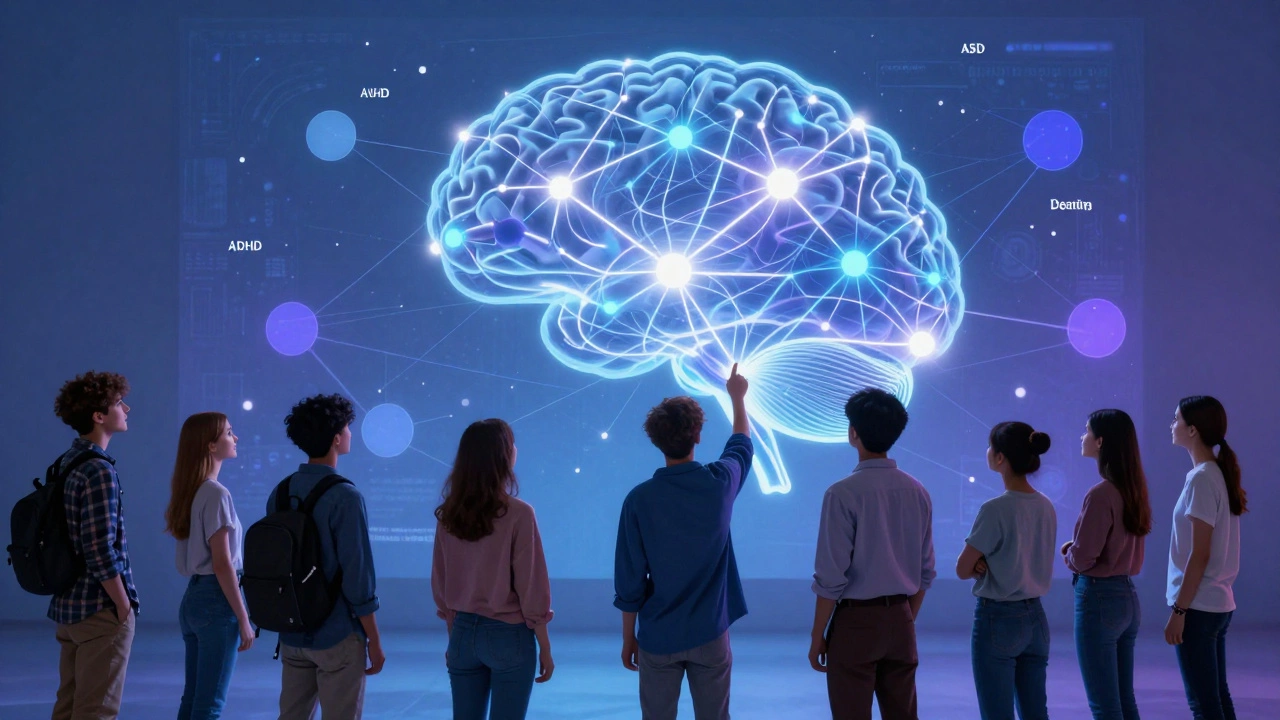
Think of the brain as a network. If certain neural pathways are wired differently during development, multiple functions can be affected simultaneously. For instance, the prefrontal cortex, which handles executive functions like attention and impulse control, interacts heavily with language centers. Disruptions in this network can manifest as both attention deficits and reading difficulties.
Understanding this clustering helps reduce stigma. It shifts the narrative from "what is wrong with this child" to "how does this child’s brain work." It also highlights the need for comprehensive evaluations rather than siloed assessments. A psychologist evaluating for dyslexia should also screen for ADHD and ASD traits, and vice versa.
Comparison of Associated Conditions
| Condition | Primary Challenge | Co-occurrence Rate with LD | Key Educational Impact |
|---|---|---|---|
| ADHD | Sustained attention, impulse control | 30-50% | Difficulty completing tasks, organizational chaos |
| Dyslexia | Phonological processing, decoding | N/A (It is an LD) | Reading fluency, spelling, written expression |
| ASD | Social communication, flexibility | 30-50% | Contextual understanding, social pragmatics in learning |
Identifying the Overlap: Signs to Watch For
Recognizing when a learning disability is accompanied by another condition requires careful observation. Here are some red flags that suggest a dual diagnosis:
- Inconsistent Performance: The student excels in hands-on activities but fails in structured academic settings, suggesting possible ADHD or ASD alongside a learning gap.
- Extreme Anxiety Around School: While all students feel stress, panic attacks or refusal to attend school may indicate undiagnosed dyslexia or ASD-related sensory overload.
- Social Isolation Despite Intelligence: A bright student who struggles to make friends or interpret social cues may have ASD, even if their primary referral was for reading difficulties.
- Working Memory Deficits: Difficulty remembering multi-step instructions can be a sign of ADHD, but it also exacerbates dyscalculia and dyslexia.
If you notice these patterns, seek a multidisciplinary evaluation. Look for professionals who specialize in neuropsychology or educational psychology. They can untangle the web of symptoms and provide a clear roadmap for intervention.
Support Strategies for Co-occurring Conditions
When multiple conditions are present, one-size-fits-all solutions do not work. Effective support requires a layered approach:
- Explicit Instruction: For dyslexia, use structured literacy programs (like Orton-Gillingham) that teach phonics explicitly. This helps regardless of attention levels.
- Environmental Modifications: For ADHD and ASD, reduce distractions. Use noise-canceling headphones, preferential seating, and visual schedules to support focus and predictability.
- Executive Function Coaching: Teach organizational skills directly. Break tasks into small steps. Use timers and checklists to manage time and attention.
- Social Skills Training: For ASD, incorporate social stories and peer-mediated interventions to build communication skills that support collaborative learning.
- Assistive Technology: Leverage tools like text-to-speech software, speech-to-text dictation, and audiobooks to bypass decoding barriers and allow access to content.
The goal is not to "fix" the brain but to provide the scaffolding needed for success. By addressing the full spectrum of challenges, we empower individuals to leverage their strengths while managing their weaknesses.
Frequently Asked Questions
Can a person have both ADHD and a learning disability?
Yes, it is very common. Approximately 30% to 50% of individuals with a specific learning disability like dyslexia or dyscalculia also have ADHD. This co-occurrence requires addressing both attention regulation and academic skill deficits simultaneously.
Is autism considered a learning disability?
No, autism spectrum disorder (ASD) is classified as a developmental disorder, not a specific learning disability. However, many autistic individuals also have learning disabilities. The two conditions are distinct but often overlap, requiring tailored educational support.
What is the most common learning disability?
Dyslexia is the most common specific learning disability, affecting 5% to 10% of the population. It involves difficulties with reading, spelling, and decoding words due to challenges in phonological processing.
How do you distinguish between ADHD and a learning disability?
ADHD affects attention, impulse control, and activity levels across all settings, while a learning disability affects specific academic skills like reading or math despite average intelligence. However, they often coexist. A comprehensive evaluation by a psychologist is needed to differentiate them accurately.
Do learning disabilities go away with age?
Learning disabilities are lifelong neurological differences. They do not go away, but individuals can learn effective coping strategies and compensation techniques. With proper support and accommodation, adults with learning disabilities can thrive in education and careers.