GCSE Study Strategy Simulator
You have a **60-minute** block of free time for revision. How do you plan to spend it? Select your approach below.
The "Grind" (Traditional)
Sit at the desk for the full hour. Re-read notes repeatedly until tired.
High VolumeThe Finnish Method
30 mins intense focus + 30 mins complete rest/walk. Quality over quantity.
Well-being FocusedSingapore Math Style
Deep dive into difficult problems. Break concepts down step-by-step.
Deep MasterySelect a strategy above to begin simulation.
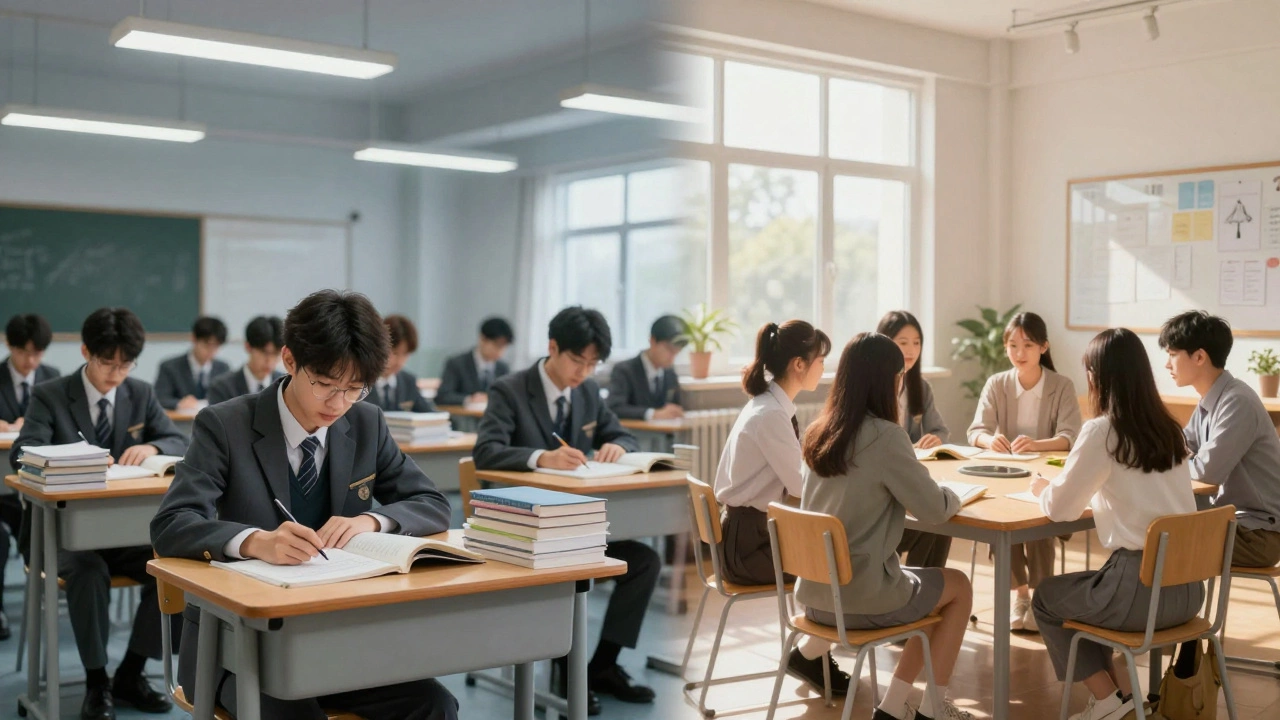
The article highlights that while East Asian systems often produce higher raw scores through volume and discipline, Northern European systems achieve similar results with less stress by prioritizing efficiency.
- Passive Review: Often leads to low retention despite high hours.
- Active Recall: Testing yourself improves memory significantly more than re-reading.
- Rest: Your brain consolidates information during breaks, making them essential for learning.
You sit down to revise for your GCSEs, staring at a stack of past papers. The pressure is real. But have you ever wondered if the system you are in is actually the best one out there? Or is it just the one you know? When people ask which country has the best education system, they usually want to know where students learn the most, achieve the highest scores, and feel the least stressed. The answer isn't as simple as pointing to one flag on a map.
Different countries prioritize different things. Some focus on rote memorization and long hours. Others focus on critical thinking and well-being. If you are a student or a parent looking at the global landscape, understanding these differences can change how you approach your own learning. It also helps explain why certain methods work better than others when it comes to subjects like math, science, and literacy.
What do the latest PISA rankings say about global education?
The Programme for International Student Assessment (PISA), run by the OECD, is the gold standard for comparing education systems. In recent cycles, East Asian economies like Singapore, Japan, and South Korea consistently rank at the top for mathematics, reading, and scientific literacy. However, European countries like Estonia and Finland often match them in performance while maintaining shorter school days and less homework. This suggests that efficiency matters more than sheer volume of study time.
The Top Performers: East Asia vs. Northern Europe
When we look at raw test scores, East Asian countries dominate. Singapore is often cited as having the world's top-performing education system. Their students score incredibly high in math and science. But this success comes with a heavy price tag: intense competition, long school hours, and significant pressure on children from a young age. The system relies on rigorous teacher training and a highly standardized curriculum.
On the other side of the spectrum, you have Finland, which prioritizes equity, teacher autonomy, and minimal testing. Finnish students don't start formal schooling until age seven. They have very little homework and no standardized tests until the end of high school. Despite this relaxed approach, they consistently perform above the OECD average. The secret? Highly respected teachers who are required to have master's degrees, and a culture that trusts educators to do their jobs without micromanagement.
Then there is Estonia, a small Baltic nation that punches way above its weight. Estonia has invested heavily in digital infrastructure, making it one of the most tech-savvy education systems in the world. Their results rival those of Singapore, but with a more balanced approach to student well-being. For anyone interested in how technology can support learning rather than distract from it, Estonia offers a compelling model.
| Country | Key Strength | School Day Length | Teacher Qualification |
|---|---|---|---|
| Singapore | Math & Science Scores | Long (6-7 hours) | Rigorous Selection |
| Finland | Equity & Well-being | Short (5 hours) | Master's Degree Required |
| Estonia | Digital Integration | Moderate | Highly Respected |
| Japan | Discipline & Ethics | Long + Clubs | Strong Training |
Where Does the UK Fit In?
If you are revising for your GCSEs, you are part of the United Kingdom's education system. The UK performs reasonably well globally, but it faces challenges. England, Wales, Scotland, and Northern Ireland each have slightly different approaches, which makes direct comparisons tricky. Generally, English students perform around the OECD average in reading and math, though they often excel in creative subjects and languages compared to some Asian counterparts.
The UK system is known for its breadth. Students take a wide range of subjects during their secondary education before specializing at A-Level or equivalent. This broad base can be an advantage for university applications, especially abroad. However, critics argue that the constant testing regime creates unnecessary stress. Unlike Finland, where trust is placed in teachers, the UK relies heavily on external accountability measures.
For a GCSE student, this means navigating a system that values both depth and breadth. You aren't just expected to memorize facts; you are expected to apply knowledge across different contexts. This is where the "best" system becomes subjective. Is the best system the one that gets the highest scores? Or the one that produces the most well-rounded, happy adults?
Lessons for Your GCSE Revision Strategy
So, what can you take away from all this global data? You don't need to move to Singapore or Finland to benefit from their methods. Here are three practical strategies inspired by the world's top performers that can help you ace your GCSEs:
- Quality Over Quantity (The Finnish Approach): Don't just sit at your desk for six hours doing nothing productive. Focus on active recall and spaced repetition. Thirty minutes of focused, high-intensity revision is worth more than two hours of distracted reading. Take breaks. Sleep well. Your brain consolidates memory during rest.
- Deep Understanding (The Singaporean Math Method): Instead of memorizing formulas, understand why they work. Break problems down into smaller steps. If you struggle with a concept, go back to the basics. Mastery of fundamentals leads to easier learning of complex topics later.
- Peer Learning (The Japanese Juku Culture): Study groups can be powerful. Explaining a concept to someone else is one of the best ways to solidify your own understanding. Find classmates who are motivated and hold each other accountable.
The Role of Technology in Modern Education
In 2026, technology is no longer optional. Countries like South Korea and Estonia have integrated tablets and interactive whiteboards into every classroom. This allows for personalized learning paths. If you are struggling with algebra, an AI tutor can provide immediate feedback and extra practice problems tailored to your level. If you are ahead, it can challenge you further.
However, technology is only a tool. It doesn't replace good teaching. The best systems use tech to free up teachers' time for human interaction-mentoring, discussing ideas, and providing emotional support. As you revise, make use of online resources. There are countless apps and websites that offer past papers, mark schemes, and video explanations. Use them wisely. Don't let notifications distract you. Set specific goals for each study session.

Beyond Test Scores: Holistic Development
Test scores tell only part of the story. What about creativity? Critical thinking? Emotional resilience? These skills are increasingly important in the modern workforce. Countries like Germany and Switzerland emphasize vocational training, giving students practical skills alongside academic knowledge. This reduces the stigma around non-university paths and ensures that everyone has a viable career option.
In the UK, the debate around vocational vs. academic routes continues. While universities remain prestigious, technical colleges and apprenticeships are gaining recognition. For many students, a hands-on approach is far more engaging than traditional classroom learning. Recognizing your own strengths and interests is crucial. Are you a theoretical thinker? Or do you learn best by doing? Tailor your revision style accordingly.
Conclusion: Finding Your Own Best System
There is no single "best" education system. Each country reflects its cultural values and economic needs. Singapore prioritizes excellence through discipline. Finland prioritizes equality through trust. The UK prioritizes breadth through structure. Your job as a student is to find the elements that work for you within your current system.
Use the insights from global leaders to enhance your own approach. Be disciplined like a Singaporean student. Be mindful of your well-being like a Finnish student. Leverage technology like an Estonian student. And remember, education is not just about passing exams. It is about becoming a curious, capable, and compassionate human being. Good luck with your GCSEs. You've got this.
Is the Singaporean education system too stressful?
Yes, it is widely considered very stressful. The pressure to perform in national exams starts early and intensifies throughout primary and secondary school. While this produces high academic achievement, it can lead to burnout and mental health issues among students. Many experts argue that the cost in terms of well-being is too high.
Why is Finland's education system so successful?
Finland's success stems from several factors: highly qualified teachers (all must have master's degrees), a lack of standardized testing, short school days, and a strong emphasis on equity. Every child, regardless of background, receives high-quality education. The system trusts teachers to design their own curricula based on student needs.
How does the UK compare to other countries in PISA?
The UK generally performs around the OECD average. England tends to score slightly higher than Scotland and Wales in some subjects, but overall, it lags behind top performers like Singapore, Japan, and Estonia. However, the UK excels in areas like creativity and language diversity, which are harder to measure in standardized tests.
What is the role of vocational training in top education systems?
Countries like Germany and Switzerland integrate vocational training early, allowing students to gain practical skills while still in school. This reduces youth unemployment and provides alternative pathways to success. It also helps bridge the gap between education and industry needs.
Can I improve my GCSE grades using international methods?
Absolutely. Adopting techniques like active recall, spaced repetition, and peer teaching-common in top-performing systems-can significantly boost your retention and understanding. Combine these with effective time management and self-care for optimal results.