Andragogy Application Guide
Based on Malcolm Knowles' theory, effective adult learning requires specific conditions. Use this guide to evaluate your training scenario.
Analysis Results
You might assume that the history of teaching grown-ups starts with a specific person who wrote the first textbook or founded the first night school. It’s a natural assumption. We like to put names on things. But when you ask, "Who is the father of adult education?" the answer isn’t just one name. It depends on whether you mean the guy who gave it a scientific name, or the people who actually started doing it centuries ago.
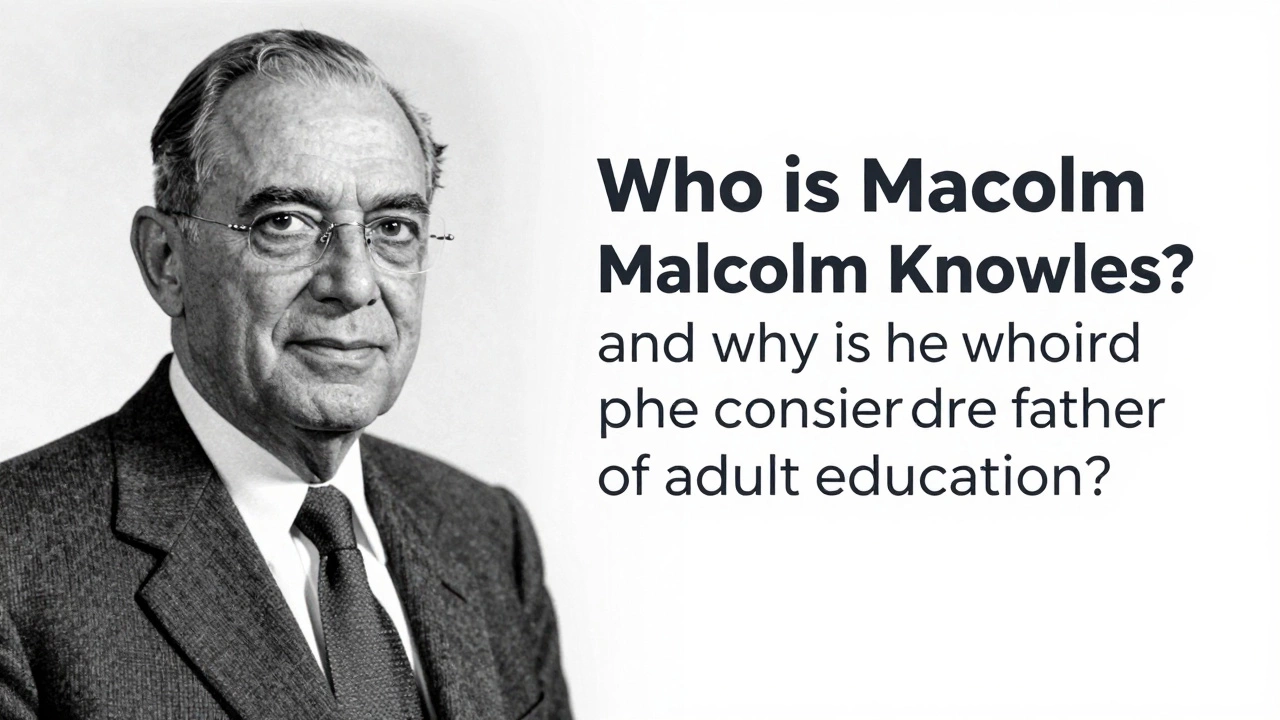
Most academic circles point to Malcolm Knowles, an American educator who popularized the term andragogy in the 1970s. He didn't invent the practice, but he built the theoretical framework that changed how we teach adults forever. Before him, teachers mostly treated adults like big children. Knowles said that was wrong. He argued that adults learn differently, and they need a different approach.
The Man Behind the Term: Malcolm Knowles
To understand why Malcolm Knowles gets the title, you have to look at what he proposed. In the mid-20th century, most educational theories were based on pedagogy, which is the method and practice of teaching children. Pedagogy assumes the learner is dependent. The teacher knows best. The student follows instructions. The curriculum is set by the institution.
Knowles flipped this script. He coined the term andragogy, often called the "science of adult learning." He wasn't the first to use the word-German educator Alexander Kapp used it in 1833-but Kapp meant it as a synonym for pedagogy. Knowles redefined it. He argued that andragogy is a distinct process from pedagogy because the nature of the adult learner changes as they mature.
His theory rests on six assumptions about how adults learn:
- Self-concept: Adults move from being dependent personalities toward being self-directed human beings. You don't want someone telling you what to do; you want to be involved in the diagnostic and planning of your instruction.
- Experience: As a person matures, their reservoir of experience grows in both quantity and quality. Experience becomes a rich resource for learning. This is why case studies and group discussions work better for adults than rote memorization.
- Readiness to learn: Adults become ready to learn those things they need to know in order to cope effectively with their real-life situations. You aren't ready to learn calculus unless you're studying engineering. You are ready to learn budgeting when you buy a house.
- Orientation to learning: Adults' time perspective changes from one of delayed application of knowledge to immediacy of application. They want to use what they learn right now.
- Motivation: While adults respond to some external motivators (better jobs, promotions), the most potent motivators are internal pressures (the desire for increased job satisfaction, self-esteem, quality of life).
- Need to know: Adults need to know why they need to learn something before undertaking it. If you can't explain the relevance, they won't engage.
This shift was revolutionary. It moved adult education from a charitable activity (like literacy programs for the poor) to a professional field with its own principles. That is why Knowles is widely cited as the father of modern adult education.
The Precursors: Who Was Doing It First?
If you dig deeper into history, you’ll find that calling Knowles the "father" ignores the giants he stood on. Education has always happened among adults, long before universities existed. In fact, most of human history consists of adults learning from other adults through apprenticeships, oral traditions, and community gatherings.
One key figure often overlooked is Paulo Freire, a Brazilian philosopher and educator. While Knowles focused on the psychological aspects of learning, Freire focused on the political and social dimensions. In his seminal work, Pedagogy of the Oppressed (1968), Freire criticized the "banking model" of education, where teachers deposit information into passive students. He argued for critical consciousness, especially for marginalized adults. For many educators in developing nations and social justice movements, Freire is the spiritual father of adult education because he linked learning to liberation.
Then there is John Dewey, the American philosopher. Dewey didn't write specifically about "adult education" as a separate category, but his pragmatic philosophy laid the groundwork. He believed education should be experiential and relevant to life. His ideas influenced Knowles directly. Without Dewey’s emphasis on democracy and experience in education, Knowles’ andragogy might never have taken shape.
In Europe, the folk high school movement in Denmark, led by N.F.S. Grundtvig in the early 19th century, is another contender. Grundtvig believed that education for adults should focus on awakening the individual’s potential and civic responsibility, not just vocational skills. These schools were non-examinational and residential, focusing on personal growth. This model spread across Scandinavia and influenced adult learning centers worldwide.
Andragogy vs. Pedagogy: The Core Difference
To really grasp why Knowles matters, you need to see the contrast between how we treat kids and how we should treat adults. Here is a breakdown of the differences based on Knowles’ framework:
| Aspect | Pedagogy (Children) | Andragogy (Adults) |
|---|---|---|
| Self-Concept | Dependent personality | Self-directed learner |
| Role of Experience | Limited; learning is preparation for life | Rich resource; learning is part of life |
| Readiness to Learn | Determined by biological and psychological development | Determined by social roles and life tasks |
| Orientation | Subject-centered | Problem-centered |
| Motivation | External (grades, praise) | Internal (self-esteem, quality of life) |
This table shows why standard classroom methods often fail with adults. If you try to teach a 40-year-old manager using a subject-centered approach (e.g., "Today we will study the history of marketing"), they will tune out. But if you use a problem-centered approach (e.g., "Let's solve this customer retention issue using marketing principles"), they will engage fully. Their experience gives them context that children simply don't have.
Critiques and Modern Perspectives
No theory is perfect, and Knowles’ andragogy has faced criticism over the years. Some scholars argue that the distinction between andragogy and pedagogy is too rigid. Not all adults are self-directed; some prefer structured guidance. Not all children are passive; some are highly curious and independent. Age is just one factor among many.
Additionally, critics point out that Knowles’ model reflects a Western, individualistic view of learning. In many collectivist cultures, learning is a communal activity, and authority figures are respected rather than questioned. The idea of the "self-directed learner" doesn't resonate universally. Modern adult education theory now incorporates transformative learning, pioneered by Jack Mezirow, which focuses on changing deep-seated beliefs and perspectives, not just acquiring new skills.
Despite these critiques, Knowles’ core insight remains valid: adults bring something to the table that children do not. That something is experience. Effective adult education leverages that experience rather than ignoring it.
Why This Matters Today
In today’s fast-changing job market, adult education is more relevant than ever. Lifelong learning is no longer a luxury; it’s a necessity. With technology evolving rapidly, professionals must constantly update their skills. Understanding andragogy helps trainers, HR departments, and online course creators design better learning experiences.
When you create training for employees, remember the "need to know." Start every session by explaining why the material matters to their daily work. Use their past experiences as examples. Encourage peer-to-peer learning, because adults trust each other’s insights. Avoid lecturing for hours; instead, use workshops, simulations, and problem-solving exercises.
The "father" of adult education may be Malcolm Knowles in the textbooks, but the true founders are the countless mentors, peers, and communities that have always helped adults navigate life’s challenges. Recognizing this lineage helps us respect the dignity and capability of adult learners everywhere.
Did Malcolm Knowles invent the concept of adult education?
No, Malcolm Knowles did not invent the practice of adult education, which has existed for centuries through apprenticeships and community learning. However, he is credited with popularizing the term "andragogy" and developing the first comprehensive theoretical framework for how adults learn differently from children.
What is the difference between andragogy and pedagogy?
Pedagogy is the method of teaching children, assuming they are dependent learners who need direction. Andragogy is the method of facilitating adult learning, assuming adults are self-directed, bring valuable experience, and need to know the relevance of what they are learning before engaging with it.
Who else is considered a key figure in adult education?
Other key figures include Paulo Freire, known for his work on critical consciousness and the banking model of education; John Dewey, whose pragmatic philosophy influenced experiential learning; and N.F.S. Grundtvig, who founded the Danish folk high school movement focused on personal and civic development.
Is andragogy applicable to all adults?
While andragogy provides useful guidelines, it is not a universal rule. Factors such as culture, individual personality, prior educational experiences, and specific learning contexts can influence how adults prefer to learn. Some adults may still prefer structured, teacher-led instruction depending on the subject matter.
How can I apply andragogy in a workplace training setting?
To apply andragogy, start by explaining the relevance of the training to employees' current roles. Involve them in setting learning goals. Use case studies and real-world problems that draw on their existing experience. Encourage discussion and peer sharing rather than one-way lectures. Focus on solving immediate, practical issues.