GCSE Grade Converter & University Estimator
Quick Reference
University Points Estimator
Enter your predicted or actual grades to see the equivalent letter grades and a rough "T-Points" total used by some universities.
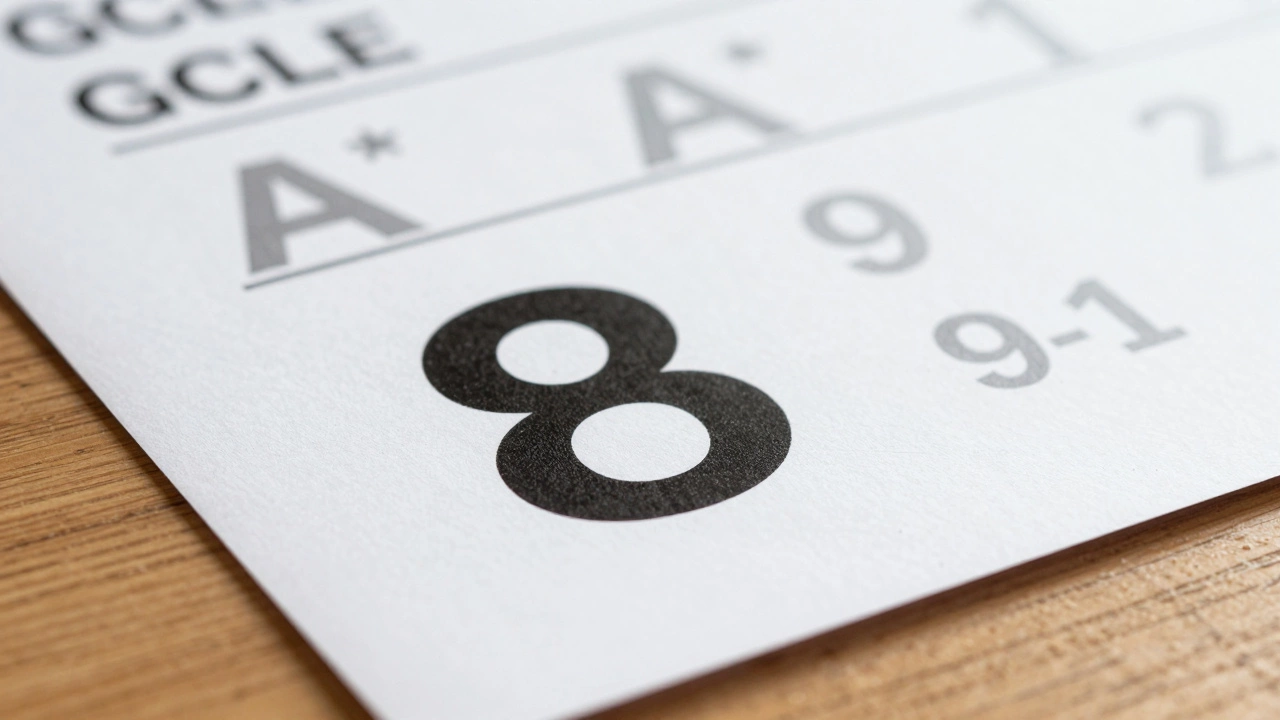
It is common to hear parents and students ask if a Grade 8 in GCSEs is the same as an A*. The short answer is yes. In fact, a Grade 8 is often considered slightly better than the old A* grade was.
If you are looking at exam results or planning your revision strategy, understanding this shift is crucial. The UK changed its grading system for most subjects in 2017. This change replaced the letter-based grades (A* to G) with a number-based system (9 to 1). While the letters are gone from official certificates, the mental comparison between numbers and letters remains strong.
The Shift from Letters to Numbers
To understand why Grade 8 equals A*, we need to look at how the new system works. The new grading structure was introduced to provide more differentiation at the top end of the ability range. Under the old system, all high achievers who scored above a certain threshold got an A*. This meant that a student who scored 95% and a student who scored 80% both received the exact same grade on their certificate: A*.
This lack of distinction made it hard for universities and employers to see the difference between top performers. The new 9-1 system fixes this by splitting the top grades into three distinct levels: 9, 8, and 7. These three grades together cover the same performance band that used to be covered by A* and A.
Here is how the top tiers break down:
- Grade 9: The highest possible grade. It represents exceptional performance, higher than the old A*.
- Grade 8: High performance. It sits within the old A* band but is lower than a 9.
- Grade 7: Strong performance. This corresponds to the old A grade.
So, when someone asks if 8 is an A*, they are correct. A Grade 8 falls squarely within the performance range that used to earn an A*. However, because the system now has a Grade 9, a Grade 8 is technically the "lower" half of what used to be the A* bracket, whereas a Grade 9 is the "upper" half.
Comparing Old and New Grades
It helps to visualize the entire spectrum. The Department for Education in the UK provided clear mapping guidelines when the change happened. Here is a direct comparison table to show where every new grade sits relative to the old system.
| New Grade | Old Grade Equivalent | Performance Level |
|---|---|---|
| 9 | A* (Higher end) | Exceptional |
| 8 | A* | Very High |
| 7 | A | High |
| 6 | B | Strong |
| 5 | C (Strong Pass) | Solid |
| 4 | C (Standard Pass) | Pass |
| 3 | D | Below Pass |
| 2 | E | Low |
| 1 | F/G | Very Low |
Notice that Grade 9 does not have a direct equivalent in the old system. It is a new creation designed to highlight the very best students. If you achieved an A* in the old system, you might have gotten a 9 or an 8 in the new system, depending on exactly how high your score was. This means a Grade 8 is definitely an A* level achievement, but it is not the absolute peak anymore.

Why Does This Matter for Students?
You might wonder why the distinction matters if both are "top grades." The reason is university admissions and competitive job applications. Top universities like Oxford, Cambridge, and Imperial College London look closely at these distinctions.
In the past, if two applicants both had five A*s, the university had little data to distinguish them based on grades alone. Now, they can see if one student has four 9s and one 8, while another has three 8s and two 7s. The first student clearly demonstrated higher mastery of the material. For a student aiming for highly competitive courses like Medicine or Law, that difference between an 8 and a 9 can be significant.
However, for most other purposes, a Grade 8 is excellent. It shows you have mastered the subject matter thoroughly. Employers generally view a Grade 8 (A*) with the same respect as they did before. It signals discipline, intelligence, and the ability to perform under pressure.
Exceptions: Subjects That Still Use Letters
It is important to note that not all GCSEs use the 9-1 numbering system. Some subjects still use the traditional A*-G letter grades. This often confuses students who see mixed results on their certificates.
The main exceptions include:
- General Qualifications (GQs): Certain vocational or specialized qualifications may retain letter grades.
- Some Arts Subjects: Occasionally, specific arts-based assessments may use different criteria, though most mainstream art GCSEs have moved to 9-1.
- International GCSEs (iGCSEs): These are often taken by students outside the UK or in independent schools. They frequently stick to the A*-G system.
If you are taking a mix of standard GCSEs and iGCSEs, your results sheet will show both numbers and letters. In this case, an A* in an iGCSE is directly comparable to a Grade 8 or 9 in a standard GCSE. Do not let the different formats worry you; the underlying standard of excellence remains consistent.

How to Aim for a Grade 8 or 9
Knowing that Grade 8 is an A* is useful, but achieving it requires a specific approach. Getting a 9 is harder than getting an 8, which is harder than getting a 7. To hit the top bands, you cannot just "know" the subject. You must demonstrate precision and depth.
Here are practical steps to target the top grades:
- Master the Specification: Read the full exam board specification (e.g., AQA, Edexcel, OCR). Know every single bullet point. Top markers look for evidence that you have covered the obscure details, not just the main concepts.
- Practice Past Papers Under Timed Conditions: Knowledge is useless if you cannot write it down quickly. Simulate the exam environment. If the paper is two hours, give yourself two hours. No distractions, no phone.
- Analyze Mark Schemes: After practicing, do not just check if you were right or wrong. Read the mark scheme line by line. Understand exactly what keywords the examiner wants. A Grade 9 answer uses the precise terminology defined in the syllabus.
- Focus on Command Words: Understand the difference between "describe," "explain," and "evaluate." A common mistake for bright students is describing when they should be evaluating. Evaluation requires judgment and reasoning, which is key for the 8 and 9 marks.
- Review Mistakes Ruthlessly: Keep an error log. Every time you get a question wrong, write down why. Was it a silly error? A lack of knowledge? Misreading the question? Fixing these patterns is what moves you from a 7 to an 8.
Common Misconceptions About the New Grades
There is a lot of anxiety surrounding the 9-1 system. One major myth is that the exams have become much harder. While the content may be more rigorous in some subjects (like Maths and English), the grading thresholds are set to ensure fairness. The percentage of students getting top grades is broadly similar to the old system, adjusted for cohort size.
Another misconception is that a Grade 4 is a "fail." It is not. A Grade 4 is a "standard pass," equivalent to the old C grade. It is the benchmark for meeting basic expectations. A Grade 5 is a "strong pass," which many sixth forms and colleges require for entry into A-Level courses. So, while 8 and 9 are elite, 4 and 5 are solid foundations for further education.
Understanding that Grade 8 is an A* helps demystify the results. It is a badge of honor. It places you in the top tier of your peer group. Whether you aim for the elusive 9 or settle for the impressive 8, you are demonstrating a high level of academic capability.
Is a Grade 8 better than an A*?
Technically, yes. A Grade 8 falls within the range of the old A* grade, but the introduction of Grade 9 means that Grade 8 is now the lower half of that top band. An A* used to cover everyone from the bottom of the top tier to the very top. Now, Grade 9 covers the very top, and Grade 8 covers the rest of the former A* range. So, a Grade 8 is equivalent to a solid A*, but not the absolute highest possible achievement anymore.
What percentage of students get a Grade 8?
The percentage varies by subject and year, but typically only about 5-10% of students achieve a Grade 8 or 9 combined. For example, in recent years, roughly 5% of candidates secured a Grade 9, and another 5-7% secured a Grade 8. This makes it a rare and prestigious achievement, reserved for the top decile of performers.
Do universities prefer Grade 8 over A*?
Universities do not "prefer" one over the other because they are comparing current students (who get numbers) with past students (who got letters). They treat them as equivalent. However, universities appreciate the nuance of the 9-1 system. If you have a Grade 8, it is viewed as a strong A*. If you have a Grade 9, it is viewed as an exceptional A*. Admissions tutors use the numerical grades to differentiate between high achievers more effectively than they could with the old system.
Can I retake a GCSE to improve from a 7 to an 8?
Yes, you can retake most GCSEs. If you have a Grade 7 (old A), you are already a strong student. Moving from a 7 to an 8 requires refining your technique and mastering finer details. Retakes are common for core subjects like Maths and English. However, check with your school or college, as some institutions have policies about retaking subjects where you have already passed strongly.
Are all GCSEs graded 9-1?
Most regulated GCSEs in England are graded 9-1. However, some International GCSEs (iGCSEs) and certain vocational qualifications still use the A*-G letter system. Additionally, some older qualifications or specific regional variations might differ. Always check the specific qualification title and awarding body to know which grading scale applies.