GCSE Revision Strategy Planner
Your Personalized Strategy
Recommended Session Structure
| Session Component | Duration | Action |
|---|---|---|
| Preparation | 5 mins | Clear desk, remove phone, set specific goal. |
| Deep Work (Active Recall) | 45 mins | Practice questions, self-quizzing, no passive reading. |
| Review & Plan | 10 mins | Check answers, identify gaps, plan next session. |
Strategic Advice:
- Aim for 1-hour blocks per subject daily rather than cramming.
- Use Spaced Repetition: Review difficult topics at increasing intervals.
- Prioritize Active Recall over re-reading notes to boost retention by up to 50%.
Imagine sitting down with your textbooks at 4:00 PM. You set a timer for sixty minutes. You read through notes on GCSE Mathematics is a core subject in the UK secondary education curriculum focusing on algebra, geometry, and statistics. At 5:00 PM, you stop. Did you just do enough? For many students staring down the barrel of their exams, this question keeps them up at night. The short answer is no, one hour is rarely enough to master a subject. But it might be exactly what you need to fix a specific weak spot.
The Myth of the Magic Number
We love simple rules. "Study for two hours," or "Read the chapter once." But human brains don't work like computer hard drives where data dumps happen instantly. Learning is a biological process involving neural pathways strengthening over time. When you ask if one hour is enough, you are really asking about Cognitive Load Theory is a framework explaining how the brain processes and stores information, emphasizing limits on working memory capacity. Your working memory can only hold so much new information before it gets overwhelmed. One hour is often the sweet spot for intense focus without burning out, but it is not a magic bullet for passing exams.
Think of it like going to the gym. Can you build muscle with one hour of exercise? Yes. Is that one hour enough to become an athlete? Probably not. It depends on what you are trying to lift. If you are trying to understand a complex concept like quadratic equations, one hour of focused practice might click it into place. If you are trying to memorize the entire periodic table for Chemistry, one hour will leave you exhausted and remembering very little.
Quality Over Quantity: The Power of Active Recall
The biggest mistake students make is confusing time spent with learning achieved. You can sit in front of a book for three hours, highlighting sentences and nodding along, and retain almost nothing. This is passive learning. To make that single hour count, you need Active Recall is a learning technique where you actively stimulate your memory during the learning process rather than passively reviewing material.. Instead of re-reading your notes, close the book and try to write down everything you remember. Then check what you missed. This struggle is where the learning happens.
Here is why this matters for your one-hour session. If you spend ten minutes setting up and five minutes skimming, you have forty-five minutes left. If you use those forty-five minutes for active recall-testing yourself with past papers or flashcards-you will retain significantly more information than if you spent two hours passively reading. Research from cognitive psychology suggests that retrieval practice strengthens memory traces far more effectively than repeated exposure to the same text.
- Passive Review: Re-reading notes, highlighting text, watching videos without pausing to think.
- Active Recall: Self-quizzing, writing essays from memory, solving problems without looking at solutions.
- Spaced Repetition: Reviewing material at increasing intervals over days and weeks.
Subject Specifics: Does It Matter What You Are Studying?
Not all subjects require the same approach. Some topics are procedural, meaning they rely on practice and repetition. Others are conceptual, requiring deep understanding. Let's look at how one hour plays out across different GCSE subjects.
| Subject Area | Best Use of 1 Hour | Limitations |
|---|---|---|
| Mathematics | Solving 3-5 difficult problems step-by-step | Hard to grasp new concepts without prior foundation |
| English Literature | Analyzing one specific scene or character arc | Insufficient for memorizing full quotes or essay structures |
| Biology | Creating diagrams and labeling processes (e.g., photosynthesis) | Too broad for covering entire systems like circulatory system |
| History | Memorizing dates and causes of a single event | Lacks context for broader historical narratives |
In Math, one hour is highly effective if you focus on problem-solving. In English, one hour might allow you to deeply analyze a poem, but it won't help you prepare for the whole paper. Context changes everything. A student struggling with Algebra is a branch of mathematics dealing with symbols and the rules for manipulating those symbols. needs targeted practice, not general review.

The Science of Spaced Repetition
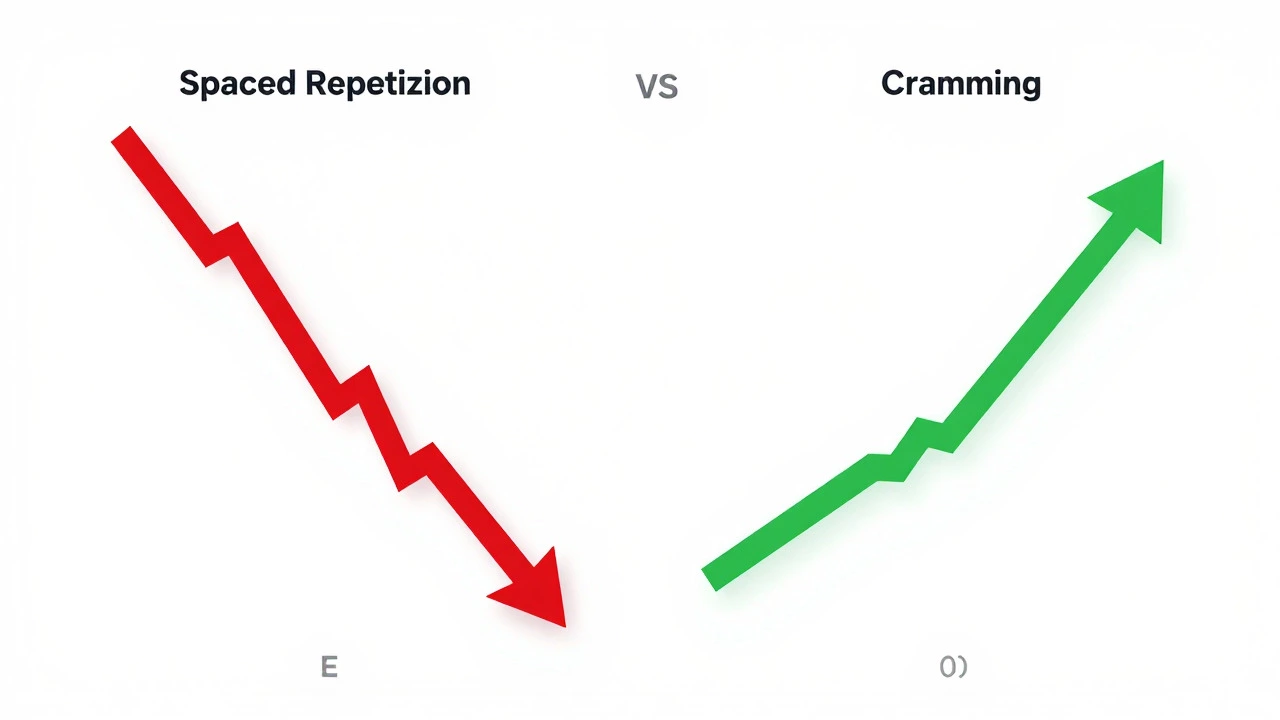
This brings us to the most critical point: consistency beats intensity. One hour today, one hour tomorrow, and one hour the next day is infinitely better than six hours on Sunday. This is known as Spaced Repetition is an evidence-based learning technique that involves reviewing information at increasing intervals to enhance long-term retention.. When you space out your study sessions, you force your brain to retrieve information just as it is about to forget it. This strengthens the neural connections.
If you cram for six hours the night before an exam, you might pass. But you will likely forget most of it within a week. If you study for one hour a day for six days, you build a durable memory. The forgetting curve, identified by Hermann Ebbinghaus, shows that we lose information rapidly after learning it unless we review it. By breaking your study into hourly chunks spread over time, you flatten that curve.
How to Structure Your Perfect One-Hour Session
So, how do you make that one hour count? You need a plan. Without structure, one hour turns into twenty minutes of scrolling social media and forty minutes of panicked reading. Here is a proven template for a high-yield study session.
- Preparation (5 minutes): Clear your desk. Put your phone in another room. Decide exactly what topic you will cover. Write it down.
- Deep Work (45 minutes): Use active recall. Do practice questions. Summarize chapters from memory. No distractions. If you get stuck, mark it and move on.
- Review and Plan (10 minutes): Check your answers. Identify what you got wrong. Write down what you need to review next time. This creates a feedback loop.
This structure ensures you are not just busy, but productive. The ten-minute review at the end is crucial because it tells your brain what is important and sets you up for the next session. It transforms a random hour into part of a larger strategy.
When One Hour Is Not Enough
There are times when one hour simply won't cut it. If you are completely lost in a subject, you might need longer sessions to build foundational knowledge. However, even then, break it up. Two thirty-minute sessions with a break in between are better than one solid hour. Your attention span wanes after about fifty minutes. Pushing past that leads to diminishing returns.
Also, consider the stakes. If you are aiming for top grades (9s and 8s) in competitive subjects, one hour a day might be the bare minimum. You may need to add extra sessions for weaker areas. But start with one hour. Build the habit. Consistency is the hardest part of studying. Once you have the habit, you can increase the duration if needed.
Troubleshooting Common Issues
What if you find yourself distracted? That is normal. The goal is not perfection; it is progress. Try the Pomodoro Technique if one hour feels too long. Break it into twenty-five minute blocks with five minute breaks. But aim to eventually stretch to the full hour. What if you don't know what to study? Go back to your past papers. Look at where you lost marks. Those gaps are your priority. Don't waste time on what you already know.
Remember, the goal of GCSE revision is not to suffer. It is to demonstrate what you know. Efficient studying reduces stress. Knowing you have put in consistent, focused hours gives you confidence. One hour is a powerful tool if you use it wisely. It is not a magic number, but it is a great starting point for building a successful study routine.
Is 1 hour of revision enough for GCSEs?
One hour is not enough to master a subject, but it is enough for a focused study session. For overall success, you need multiple one-hour sessions spread over weeks using spaced repetition. Consistency matters more than duration.
How many hours should I study per day for GCSEs?
Aim for 1-2 hours of focused study per day during term time. Increase this to 3-4 hours in the weeks leading up to exams. Quality of focus is more important than total hours logged.
What is the best way to revise in 1 hour?
Use active recall. Spend 5 minutes planning, 45 minutes doing practice questions or self-testing, and 10 minutes reviewing mistakes. Avoid passive reading or highlighting.
Can I cram for GCSEs in one day?
Cramming is ineffective for long-term retention. While you might remember some facts temporarily, you will likely struggle with application and analysis questions. Start revising early with spaced sessions.
Does studying late at night work?
Sleep is crucial for memory consolidation. Studying right before bed might help some people, but sacrificing sleep hurts performance. Aim for consistent study times earlier in the day.