Effective Learning Strategy Planner
Discover the best way to learn new skills based on your personal preferences and lifestyle.
Your Learning Profile
Fill out your profile on the left and click "Generate My Plan" to see personalized strategies for learning effectively after 60.
You might have heard the myth that your brain stops growing once you hit retirement age. It’s a persistent idea, but it’s wrong. Your brain remains capable of forming new connections, learning new skills, and adapting to new information well into your seventies, eighties, and beyond. The challenge isn’t capacity; it’s strategy. Learning at 60+ requires a different approach than studying for a college exam at 20. You’re not trying to memorize facts for a test next week; you’re building competence for life.
If you are wondering how can I learn after 60, the answer lies in leveraging your existing strengths while adapting to how your cognitive processes have shifted. This guide breaks down the science, the methods, and the practical steps to make learning enjoyable and effective again.
The Myth of Cognitive Decline
Let’s clear up the confusion about aging brains. Yes, processing speed-the time it takes to react to a stimulus-does slow down slightly with age. But this is just one metric. Neuroplasticity is the brain's ability to reorganize itself by forming new neural connections throughout life. Research from institutions like the National Institute on Aging confirms that neuroplasticity persists until death. What changes is not the ability to learn, but the method that works best.
Younger brains excel at rote memorization and rapid acquisition of raw data. Older brains excel at pattern recognition, contextual understanding, and integrating new knowledge with existing wisdom. Think of it this way: a young computer has a faster processor but less storage and organization. An older computer has slower processing but a vast, highly organized database. When you learn something new, you aren’t starting from scratch; you’re adding files to an already robust system. This makes deep understanding easier, even if initial recall feels slower.
Why Motivation Changes Everything
One of the biggest advantages of learning after 60 is autonomy. In school or early career, you often learned because you had to. Now, you learn because you want to. This intrinsic motivation is a powerful cognitive enhancer. Dopamine, the neurotransmitter associated with reward and focus, releases more strongly when you engage in activities you find personally meaningful.
Consider two scenarios. In Scenario A, you take a mandatory software training course. You feel bored, distracted, and resistant. In Scenario B, you decide to learn digital photography because you want to capture better images of your grandchildren. You spend hours reading manuals and practicing settings, yet time flies. Why? Because the goal is tied to personal value. To learn effectively now, tie every new skill to a tangible, desirable outcome. Don’t just "learn Spanish"; learn Spanish so you can chat with your neighbor who speaks only that language. Specific goals trigger sustained attention.
Adapting Study Techniques for Mature Minds
Traditional study habits like cramming or passive highlighting often fail for older adults. Instead, adopt strategies that align with how mature brains process information.
Spaced Repetition Over Cramming
Cramming relies on short-term memory, which becomes less efficient with age. Spaced repetition involves reviewing material at increasing intervals over time. This technique strengthens long-term retention. Use apps like Anki or simply schedule review sessions: study a topic today, review it tomorrow, then in three days, then in a week. This spacing allows your brain to consolidate memories during sleep.
Chunking Information
Your working memory capacity may be smaller than it was at 25. Trying to hold seven new pieces of information at once is harder. Break complex topics into small, manageable "chunks." If you’re learning a new recipe, don’t try to memorize all twelve ingredients at once. Group them: aromatics (onion, garlic), proteins (chicken, tofu), and seasonings (salt, pepper). Master one group before moving to the next.
Active Recall
Passive reading gives a false sense of mastery. Active recall forces your brain to retrieve information without looking at notes. After reading a chapter, close the book and write down everything you remember. Then check what you missed. This struggle to retrieve strengthens neural pathways far more than re-reading ever will.
Leveraging Technology Without Frustration
Technology is often cited as a barrier for older learners, but it doesn’t have to be. The key is choosing tools designed for clarity rather than complexity.
| Tool Type | Best For | Challenge | Mitigation Strategy |
|---|---|---|---|
| Video Courses (YouTube/Udemy) | Visual learners, step-by-step demos | Pacing too fast, ads | Use playback speed controls (0.75x); use ad-blockers |
| Language Apps (Duolingo/Babbel) | Daily habit formation, gamification | Repetitive exercises can feel childish | Set daily goals; focus on conversation modules |
| Audiobooks/Podcasts | Learning while walking or resting | Hard to pause and reflect | Take voice memos immediately after listening |
| Community Classes (Local Library) | Social interaction, accountability | Fixed schedules | Treat attendance as a social commitment |
Start small. If you want to learn coding, don’t buy a $500 textbook. Try a free interactive platform like Codecademy or Khan Academy. These platforms offer immediate feedback, which reduces anxiety. If you get stuck, look for communities specifically for older learners. Sites like SeniorNet provide forums where peers share tips tailored to your demographic, removing the intimidation factor often found in general tech support.
The Role of Social Learning
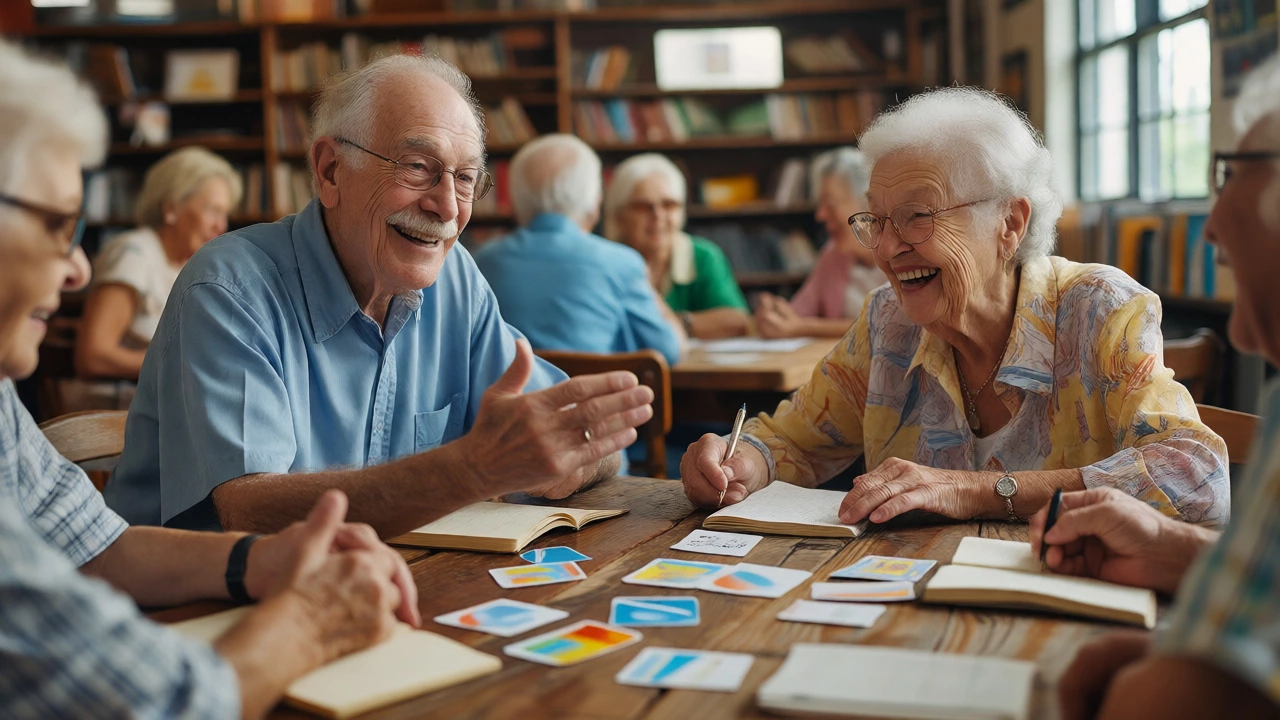
Isolation is the enemy of learning. When you study alone, motivation wanes. When you study with others, accountability rises. Social Learning Theory, developed by psychologist Albert Bandura, suggests that people learn from one another via observation, imitation, and modeling. At 60+, this principle is doubly important because social interaction also supports cognitive health.
Join a local club related to your interest. Want to learn gardening? Join the community garden team. Interested in history? Attend a lecture series at a nearby university-many offer senior discounts or free access. Teaching what you’ve learned to someone else is also a powerful retention tool. Explain the basics of chess to a grandchild or discuss a new political concept with a friend. Articulating ideas forces you to organize your thoughts clearly, revealing gaps in your understanding.

Physical Health Supports Mental Agility
You cannot separate the brain from the body. Physical activity increases blood flow to the brain, delivering oxygen and nutrients essential for neuron function. A study published in the journal Neurology found that regular aerobic exercise improved memory and thinking skills in older adults more effectively than sedentary behavior.
- Walking: Just 30 minutes of brisk walking daily boosts BDNF (Brain-Derived Neurotrophic Factor), a protein that supports neuron growth.
- Sleep: Memory consolidation happens during deep sleep. Prioritize 7-8 hours of quality rest. Poor sleep directly impairs your ability to retain new information.
- Nutrition: Omega-3 fatty acids, found in fish and flaxseeds, support brain cell structure. Hydration is equally critical; even mild dehydration reduces concentration.
Treat your body as the hardware running your learning software. If the hardware overheats or lacks power, the software slows down.
Overcoming Fear and Perfectionism
Many older adults hesitate to start learning because they fear embarrassment. They worry about making mistakes in front of younger instructors or peers. Let go of perfectionism. Mistakes are data points, not failures. When you mispronounce a French word or miss a note on the piano, your brain registers the error and adjusts. That adjustment is learning.
Give yourself permission to be a beginner again. It feels vulnerable, but it’s liberating. You’re not competing with anyone. You’re expanding your world. Celebrate small wins. Did you remember a name? Win. Did you finish a module? Win. Progress, not perfection, is the goal.
Is it really possible to learn a new language after 60?
Yes, absolutely. While you may not achieve native-like accent pronunciation as easily as a child, you can reach conversational fluency. Adults actually have an advantage in grammar and vocabulary acquisition due to existing linguistic knowledge. Focus on communication rather than perfection. Consistency matters more than intensity; 15 minutes daily beats two hours once a week.
How much time should I dedicate to learning each day?
Short, frequent sessions are more effective than long marathons. Aim for 20-30 minutes per day. This prevents mental fatigue and keeps motivation high. If you feel energized, extend the session, but stop before you feel drained. Consistency builds habit; duration builds endurance.
What if I forget things quickly?
Forgetting is normal and part of the learning process. Use external aids like notebooks, calendars, or reminder apps. Practice active recall regularly. If you forget a fact, look it up again-this second retrieval strengthens the memory trace. Be patient with yourself; repetition is the key to retention.
Are online courses suitable for beginners over 60?
Yes, many online platforms are user-friendly. Look for courses with large fonts, clear audio, and step-by-step instructions. Start with free introductory courses to test the interface. If technology feels overwhelming, consider hybrid models that combine online videos with in-person discussion groups.
Does learning help prevent dementia?
While learning doesn't guarantee prevention, studies suggest that engaging in mentally stimulating activities builds cognitive reserve. This reserve helps the brain compensate for age-related changes, potentially delaying symptoms of dementia. Lifelong learning is a protective factor for brain health.