Distance Learning Cost Estimator (2026)
Program Details
Hidden Costs & Expenses
Estimated Cost Breakdown
Picture this: you’re sitting on your couch in Burlington, Vermont, laptop open, ready to start that degree you’ve been putting off. You click "Apply" and see a number that makes you blink. Is it cheaper than campus life? Or is it just as expensive with the added hassle of bad Wi-Fi? The short answer is: it depends. But the longer answer is that distance learning can save you thousands if you know where to look-and cost you more if you pick the wrong program.
In 2026, the landscape of online education has shifted dramatically. It’s no longer just about taking a few electives remotely. We’re talking full degrees, certifications, and even doctoral programs delivered entirely through screens. But with so many options, from massive open online courses (MOOCs) to accredited university partnerships, figuring out the real cost is tricky. Let’s break down exactly what you’ll pay, who pays it, and how to keep your wallet happy while getting educated.
The Big Picture: Online vs. On-Campus Tuition
First, let’s clear up a common myth. Many people assume that because you aren’t paying for dorms or meal plans, online tuition is automatically half-price. That’s not always true. In fact, many traditional universities charge the exact same tuition rate for their online students as they do for those walking across campus. Why? Because the faculty, curriculum development, and administrative overhead are largely the same.
However, there are exceptions. Public universities often have a "resident" tuition rate for in-state students. If you live in New York but take an online course from NYU, you might be charged out-of-state rates, which can be double or triple the resident price. Conversely, some institutions offer specific "online-only" discounts to attract a broader audience. For example, some state universities now cap online tuition at the in-state rate regardless of where you live. This is a game-changer for international students or those living in high-cost states like California or New York.
To give you a realistic baseline, here’s what you can expect in 2026:
- Public Universities (In-State): $10,000 - $15,000 per year for undergraduate degrees.
- Public Universities (Out-of-State): $20,000 - $35,000 per year.
- Private Non-Profit Universities: $25,000 - $45,000 per year.
- For-Profit Online Colleges: Highly variable, often $15,000 - $30,000 per year, but beware of hidden fees.
Notice the gap? Choosing a public institution that offers residency reciprocity agreements can save you tens of thousands over a four-year degree. States like West Virginia, Maine, and Arizona have pioneered these models, allowing students from neighboring states to pay lower rates for online degrees.
Hidden Costs That Add Up Fast
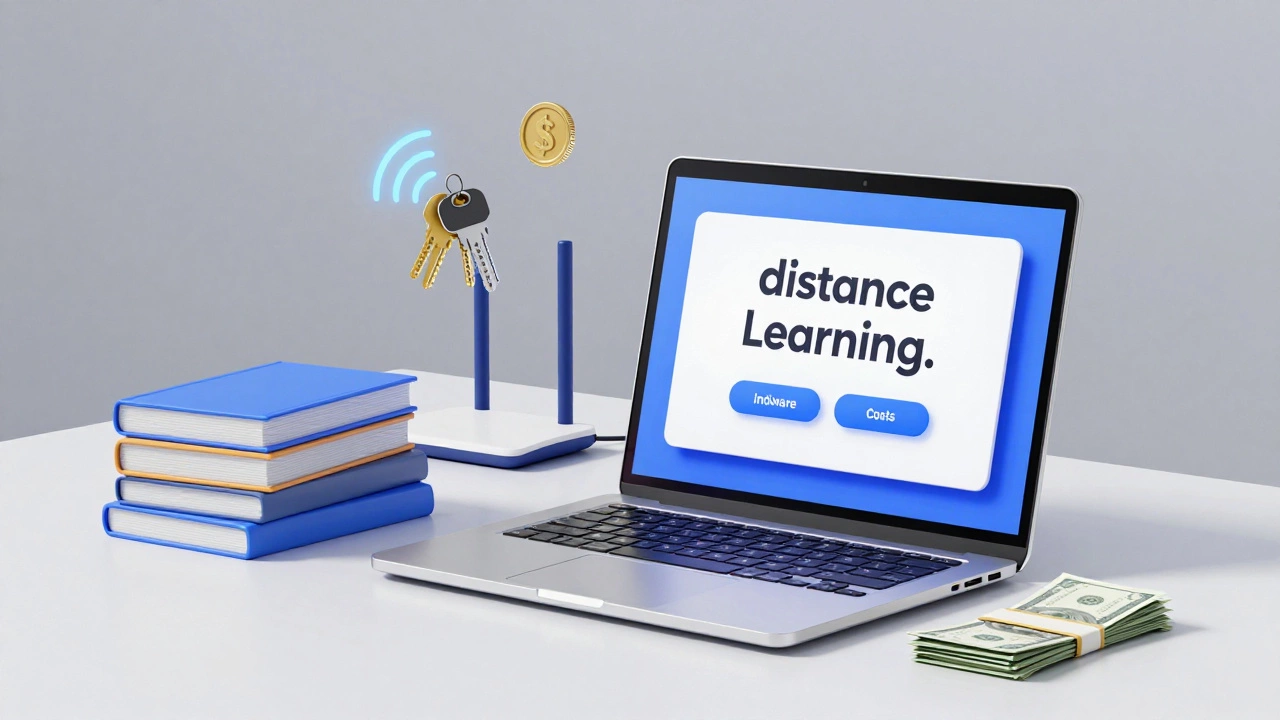
Tuition is just the tip of the iceberg. When you calculate the total cost of attendance, you need to account for the "invisible" expenses that don’t show up on the first page of the financial aid form. These costs vary wildly depending on your discipline and technical setup.
Let’s talk technology. If you’re studying liberal arts, you might get by with a standard laptop and a stable internet connection. But if you’re pursuing engineering, nursing, or graphic design, you’ll likely need specialized software. Adobe Creative Cloud subscriptions run around $60 per month. Statistical analysis tools like SPSS or MATLAB can cost hundreds annually. Some schools provide free licenses; others expect you to buy them. Always check the syllabus before you commit.
Then there’s hardware. Do you already have a reliable computer? If not, factor in $800-$1,500 for a machine that can handle video conferencing and heavy multitasking without crashing during finals week. Internet access is another non-negotiable. While most households have broadband, rural areas still struggle with speed and reliability. If you need to upgrade your plan or install a mesh network to cover your home, that’s $20-$50 more per month.
Don’t forget textbooks and materials. Even in the digital age, many professors require physical lab kits, art supplies, or printed case studies. However, online programs often use digital resources, which can cut textbook costs by 50% or more. Look for programs that use Open Educational Resources (OER)-free, peer-reviewed textbooks that eliminate this expense entirely.
| Expense Category | Low Estimate | High Estimate | Notes | |
|---|---|---|---|---|
| Software Licenses | $0 | $1,200 | Depends on major; STEM fields cost more | |
| Hardware/Upgrades | $0 | $1,500 | One-time cost if new equipment needed | |
| Internet Upgrade | $0 | $600 | Annualized cost of higher-speed plan | |
| Textbooks/Materials | $200 | $1,000 | Digital/OER reduces this significantly | |
| Proctoring Fees | $0 | $300 | Some exams require remote proctoring services |
Financial Aid and Scholarships for Online Students
Here’s the good news: federal financial aid works for online students too. As long as the institution is accredited and participates in Title IV programs, you can apply for FAFSA (Free Application for Federal Student Aid). This opens the door to Pell Grants, Direct Subsidized Loans, and Work-Study programs. The key is accreditation. Never enroll in an unaccredited online diploma mill thinking you’ll save money. You won’t qualify for aid, and employers won’t recognize the degree.
Beyond federal aid, many private scholarships are now open to distance learners. Organizations like the Society for Information Technology & Teacher Education (SITE) offer grants specifically for online education. Additionally, some employers sponsor continuing education. If you’re working while studying, ask your HR department about tuition reimbursement policies. Many companies will cover 50-100% of your tuition if the degree relates to your job.
State-level aid is also evolving. Some states offer "tuition exchange" programs for online residents. For instance, if you live in Vermont but attend an online program in a partner state, you might pay reduced rates. Check your state’s higher education agency website for current reciprocity agreements.
Alternative Models: MOOCs, Microcredentials, and Bootcamps
If a four-year degree feels too expensive or time-consuming, consider alternative pathways. Massive Open Online Courses (MOOCs) from platforms like Coursera, edX, and Udacity offer individual courses for as little as $49-$79. You can audit many courses for free, though you won’t get a certificate or credit. This is perfect for skill-building without the debt burden.
Microcredentials and bootcamps are another option. These intensive, short-term programs focus on specific skills like coding, data analysis, or digital marketing. They typically last 3-6 months and cost between $5,000 and $15,000. While not equivalent to a bachelor’s degree, they can lead to immediate job placement and higher salaries. Companies like Google and IBM now offer professional certificates that are recognized by employers, providing a low-cost entry point into tech careers.
Community colleges also offer robust online associate degrees. These two-year programs cost a fraction of four-year universities and can transfer to larger institutions. If you complete your general education requirements online at a community college, you can save $10,000+ before transferring to a university for your major-specific courses.
How to Choose the Right Program Without Breaking the Bank
So, how do you decide? Start with your goals. Are you looking for career advancement, a career change, or personal enrichment? Your answer dictates the best value proposition.
If you need a credential for promotion, prioritize accredited programs with strong employer recognition. Don’t chase the cheapest option if it lacks prestige. Instead, look for regional accreditation, which ensures quality and transferability. Then, negotiate. Some universities offer tuition discounts for military veterans, alumni, or bulk enrollment (taking multiple credits at once).
If you’re switching careers, consider bootcamps or microcredentials. They’re faster and cheaper, with a direct ROI link. Research job placement rates and average salary increases for graduates. Platforms like Course Report and SwitchUp provide transparent data on this.
Finally, build a budget. Include tuition, hidden costs, and opportunity costs (lost wages if you reduce work hours). Use online calculators from the Department of Education to estimate loan repayments. Remember, the cheapest program isn’t always the best value if it doesn’t lead to your desired outcome.
Real-World Scenarios: What Does It Actually Cost?
Let’s ground this in reality. Meet Sarah, a nurse in Vermont wanting to become a Nurse Practitioner. She compares three options:
- Local University Online: $18,000/year tuition + $500 software + $300 proctoring = $18,800/year. Total for 2 years: $37,600.
- Out-of-State Prestigious School: $30,000/year tuition + $800 software = $30,800/year. Total: $61,600.
- Community College Transfer Path: $4,000/year for first 2 years (AA degree) + $15,000/year for final 2 years at university = $38,000 total.
Sarah chooses option 3. She saves nearly $24,000 by starting locally and transferring. Her advice? "Map out every credit hour. Know what transfers. Don’t assume everything does."
Now consider Mike, a marketing manager in New York seeking a digital analytics certification. He opts for a Google Professional Certificate via Coursera at $39/month for 6 months ($234 total). He lands a raise within a year. His ROI? Massive. His debt? Zero.
These examples show that "how much is distance learning" isn’t a single number. It’s a strategic decision based on your path, patience, and priorities.
Is online tuition really cheaper than on-campus?
Not necessarily. Many universities charge the same tuition for online and on-campus students. However, you save on housing, meals, transportation, and campus fees. Additionally, some public universities offer discounted online rates for out-of-state students, making it effectively cheaper overall.
Can I get financial aid for online degrees?
Yes, as long as the school is accredited and participates in federal student aid programs. You can apply for FAFSA to receive grants, loans, and work-study funds. Private scholarships and employer tuition reimbursement are also available for online learners.
What are the hidden costs of distance learning?
Hidden costs include software licenses, hardware upgrades, high-speed internet, textbooks, and proctoring fees. STEM and creative fields often require expensive tools. Always check the program’s technology requirements before enrolling to avoid surprise bills.
Are MOOCs worth the money compared to degrees?
It depends on your goal. MOOCs are excellent for skill-building and cost a fraction of a degree. However, they don’t replace accredited degrees for jobs requiring formal credentials. Use MOOCs for supplemental learning or career pivots where portfolios matter more than diplomas.
How do I find affordable online programs in my state?
Check your state’s higher education agency website for reciprocity agreements. Look for public universities that offer flat-rate online tuition regardless of residency. Also, explore community colleges for transferable associate degrees, which are significantly cheaper than four-year institutions.