A-Level Subject Perception Calculator
Select your A-Level subjects to see how they are perceived by top universities (Russell Group), general institutions, and employers.
Subject Analysis Results
You’ve spent three years grinding through exams, missing weekends, and sacrificing sleep for those final grades. You get your results, and you’re ready to celebrate. But then you hear it: “Oh, that’s a soft subject.” Or worse, you see a conditional offer from a top-tier university that requires an A in Math but only a B in your other subjects, while your friend with similar grades gets a different deal because of what they studied. It stings. And it raises a uncomfortable question: are all A-level subjects created equal in the eyes of universities and employers?
The short answer is no. While every A-level is rigorous and deserves respect, the reality of higher education admissions in the UK is starkly hierarchical. Some subjects open doors; others keep them slightly ajar. This isn’t about intelligence or effort-it’s about perception, utility, and the specific demands of competitive courses.
The Hierarchy of Subjects at Top Universities
To understand which A-levels are viewed as "less respected," we first need to look at who is doing the respecting. For most universities, especially outside the Russell Group, an A-level in Art is just as valuable as one in Physics if the grade is high. However, when you target elite institutions like Oxford, Cambridge, Imperial College London, or LSE, the landscape changes dramatically.
These institutions often publish lists of "facilitating subjects"-courses that are common among applicants to degree programs in medicine, law, engineering, and sciences. When a subject falls outside this list, it doesn't mean it's bad. It means it's less versatile for STEM (Science, Technology, Engineering, and Mathematics) pathways. Consequently, subjects that lack this broad applicability often face skepticism from admissions tutors looking for academic rigor across a wide range of potential degrees.
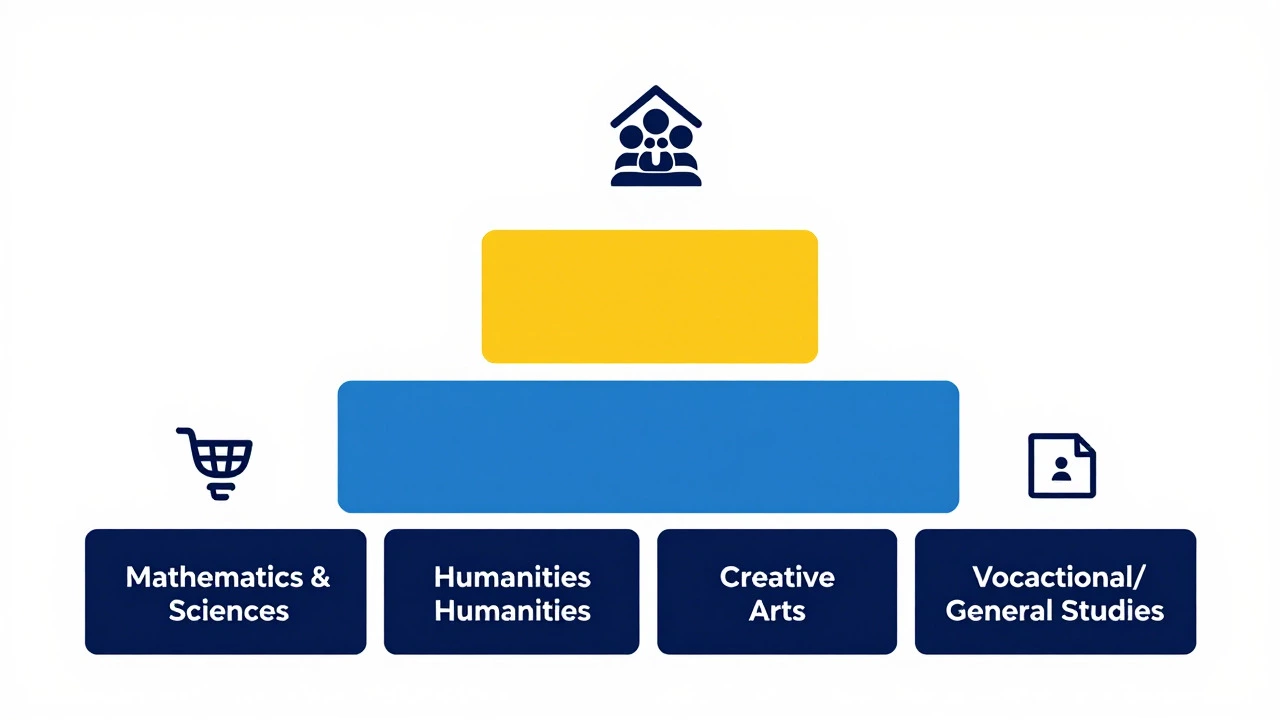
| Subject Category | Russell Group Perception | General University Perception | Employer View (Non-Specialist) |
|---|---|---|---|
| Mathematics & Sciences | Highly Preferred | Respected | Strong Signal of Analytical Skill |
| Humanities (History, English) | Preferred for Arts/Law | Highly Respected | Good Communication Skills |
| Creative Arts (Art, Drama) | Niche/Specialist Only | Respected for Creativity | Varies Widely |
| Vocational/General Studies | Often Excluded | Mixed | Practical Skills Valued |
The "Soft Subject" Controversy
The term "soft subject" is controversial and often misused. In academic circles, it refers to subjects where assessment relies heavily on subjective interpretation rather than objective fact. Critics argue that grading in these areas can be inconsistent compared to the binary right-or-wrong nature of mathematics or physics. Proponents counter that these subjects develop critical thinking, empathy, and complex communication skills that are equally vital.
Despite the debate, certain A-levels consistently appear at the bottom of preference lists for general undergraduate admissions. Here are the most commonly cited examples:
- General Studies: Once popular, this subject has been largely dismantled by universities. It covers a bit of everything-politics, psychology, geography-but masters none. Admissions tutors view it as a lack of focus. Most Russell Group universities do not accept it towards their entry requirements.
- Media Studies: Often criticized for being too theoretical without practical application. While media literacy is crucial, the A-level is sometimes seen as lacking the academic depth required for rigorous university study unless paired with stronger core subjects.
- Sociology: This is a polarizing subject. Some universities love it for its relevance to social sciences; others dismiss it as "pop psychology." The key issue is often how it's taught. If it lacks statistical rigor, it may be viewed skeptically by data-driven departments.
- Psychology (A-Level): Don't confuse this with Psychology at university. The A-level is often criticized for being too descriptive and not analytical enough. Many universities prefer students to take Biology or Math instead, arguing that the A-level doesn't prepare you well for the scientific method used in degree-level psychology.
- Drama & Theatre Studies: Like Art, this is highly respected if you're applying for drama schools. But for a general degree? It’s often seen as a hobby rather than an academic discipline. The performance-based assessment can also raise questions about standardization compared to written exams.
Why Do These Perceptions Exist?
It’s important to dig deeper than just "bias." There are structural reasons why some subjects are viewed differently.
1. Predictive Validity
Universities want to know if you can handle their coursework. If you’re applying for Law, History shows you can analyze texts and construct arguments. If you’re applying for Engineering, Math shows you can solve problems. Subjects like General Studies don’t provide a clear signal of your ability to handle specialized, intense academic work.
2. Grading Consistency
Subjects with external, standardized exams (like Math or Chemistry) have less room for teacher bias. Creative subjects often involve coursework portfolios assessed internally. While moderated, this process introduces variability that large-scale admissions teams find harder to compare across thousands of applicants.
3. Market Saturation
Many students choose "easier" subjects hoping for higher grades. When a subject becomes overcrowded with students seeking a quick A*, the grade itself loses some of its prestige. An A in Math is harder to achieve statistically than an A in some creative subjects, making the former more impressive to admissions officers.
The Impact on Your Applications
So, does taking a "less respected" A-level ruin your chances? Not necessarily. Context matters immensely.
If you apply for a course directly related to your subject-say, Media Studies for a Journalism degree-your A-level will be viewed positively. The issue arises when you try to use a niche subject to gain entry into a competitive, unrelated field. For example, applying for Medicine with A-levels in Drama, Sociology, and General Studies would be a red flag for any medical school.
However, many universities now practice "contextual admissions." They look at your background, your school’s performance, and the challenges you’ve faced. If you took challenging subjects within your context, even if they aren’t traditional "hard" sciences, admissions tutors will recognize your effort and capability.
How to Mitigate the Risk
If you’re passionate about a subject that’s often overlooked, you can still succeed. Here’s how to protect your applications:
- Pair Smartly: Combine a "softer" subject with a "hard" one. For instance, pair Media Studies with History or Politics. This shows you have both creative flair and analytical rigor.
- Explain Your Choice: Use your personal statement to articulate why you chose these subjects. Show how they’ve developed transferable skills like research, critical analysis, or project management.
- Focus on Grades: An A* in a "less respected" subject is always better than a C in a "respected" one. Excellence speaks louder than subject stigma.
- Check Entry Requirements: Before committing, read the small print. Some courses explicitly state they do not accept certain subjects. Don’t assume-they’ll tell you.
- Consider EPQs: An Extended Project Qualification (EPQ) can demonstrate independent research skills, compensating for any perceived lack of academic depth in your main subjects.
The Changing Landscape
The conversation around A-levels is evolving. Employers and universities are increasingly recognizing the value of diverse skill sets. Emotional intelligence, creativity, and adaptability are becoming as important as raw analytical power.
Moreover, the rise of vocational qualifications and T-Levels is reshaping the post-16 landscape. As society moves away from a purely academic model, the stigma around non-traditional A-levels may diminish. Subjects like Business Studies, once dismissed as "easy," are gaining respect due to their practical relevance and alignment with modern economic needs.
Still, for now, the hierarchy remains. Understanding it isn’t about conforming to elitism-it’s about navigating the system strategically. Know where you stand, play to your strengths, and never let a label define your potential.
Is General Studies accepted by any universities?
Most Russell Group universities do not accept General Studies towards their entry requirements. Some smaller or regional universities may consider it, but it is rarely counted as a full A-level equivalent. Always check the specific course page.
Can I get into Oxford or Cambridge with "soft" A-levels?
Yes, but it depends on the course. For humanities courses like PPE (Philosophy, Politics, and Economics), subjects like History and English Literature are highly respected. For science courses, you will typically need Math and Sciences. "Soft" subjects like Media Studies are generally not suitable for Oxbridge applications unless specifically relevant to a niche arts course.
Do employers care about "less respected" A-levels?
Most graduate employers care more about your degree class and university reputation than your specific A-level subjects. However, for competitive internships or roles requiring analytical skills, having Math or Sciences can give you an edge. For creative industries, subjects like Art or Drama can actually be a positive signal.
What is the difference between AS and A-level Psychology?
AS Psychology provides an introduction to key concepts, but A-level Psychology goes deeper into research methods and statistics. However, many universities still prefer A-level Biology or Math over Psychology for degree-level psychology courses because they believe the A-level doesn't provide sufficient scientific grounding.
Should I drop a "soft" subject if I'm aiming for a top university?
Not necessarily. If you enjoy the subject and can achieve high grades, keep it. Pair it with stronger academic subjects to balance your profile. Dropping a subject you love might lower your motivation and grades overall, which is worse than having a mixed portfolio.