Andragogy Alignment Score Calculator
Evaluate a specific course, workshop, or study method against Malcolm Knowles' 5 pillars to see if it truly supports adult learners.
Pillar 1 The Need to Know
Does the learning material explicitly state why this is relevant and what benefit the learner will gain?
Pillar 2 Self-Concept
Does the format allow learners to direct their own path, pace, or participation?
Pillar 3 Role of Experience
Does the content leverage the learners' prior knowledge and life experience?
Pillar 4 Readiness to Learn
Is the content timed to match the learner's current social or professional role needs?
Pillar 5 Orientation to Learning
Is the focus on solving real-world problems rather than memorizing abstract subjects?
--
out of 50 points
Waiting for input...
Select options above and click calculate to analyze your approach.
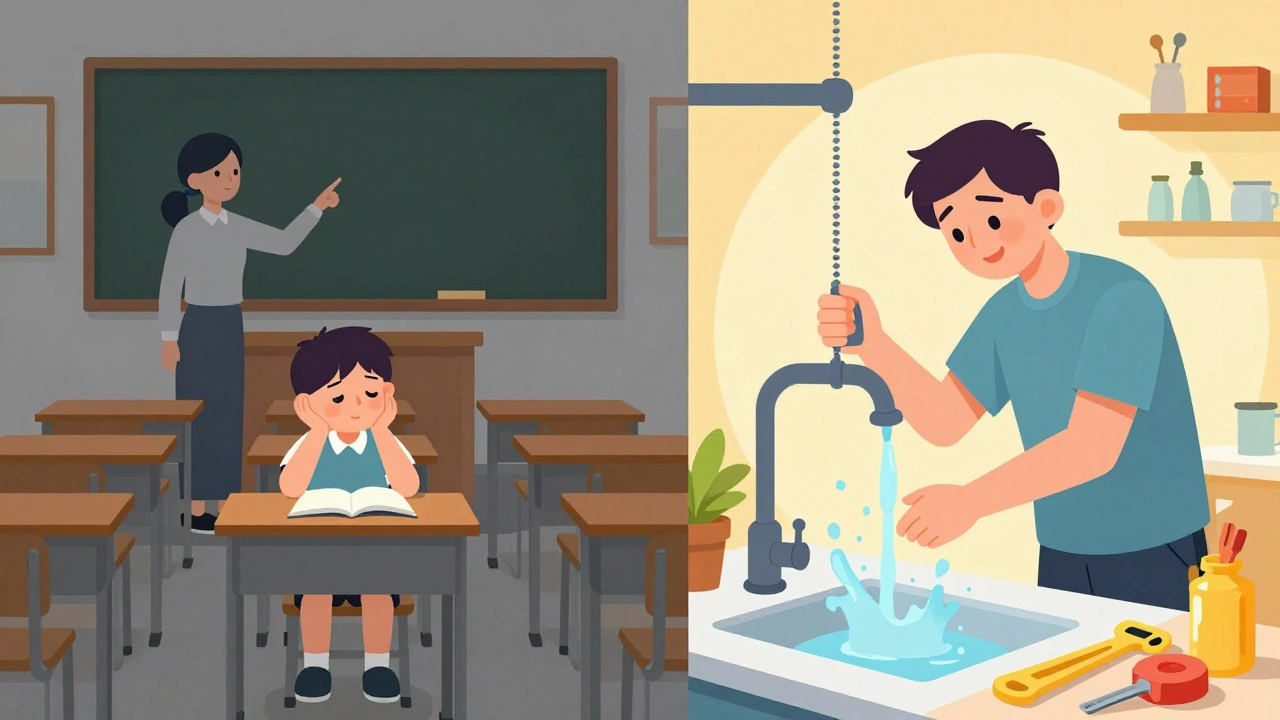
Think back to the last time you learned something genuinely useful. Was it sitting in a lecture hall, taking notes on a topic that felt irrelevant? Or was it fixing a leaky faucet because your kitchen was flooding? For most of us, the latter sticks. We learn best when we have to.
This isn't just a feeling; it's science. Adults don't learn like children. Our brains are wired differently, our motivations are sharper, and our time is scarcer. If you're trying to train employees, design an online course, or even just study for a certification, ignoring how adults actually absorb information is like building a house without a foundation. It might stand up for a while, but it won't last.
The framework that explains this shift is called Andragogy, defined as the method and practice of teaching adult learners, distinct from pedagogy (child education). Coined by educator Edgar Dale in 1968 and popularized by Malcolm Knowles in the 1970s, Andragogy rests on five specific pillars. Understanding these pillars changes everything about how you approach skill acquisition.
Pillar 1: The Need to Know Why
Children often learn because they are told to. "Do your math homework." "Clean your room." Compliance is the driver. But try telling an adult to spend three hours studying a new software protocol without explaining why it matters. You’ll get resistance. Not because adults are stubborn, but because they are pragmatic.
The first pillar of adult learning is the Need to Know. Before an adult commits mental energy to a task, they need to understand the benefit. They ask themselves: "How does this help me right now?" or "What problem does this solve?"
If you are designing a training module, start with the outcome, not the theory. Don't begin with "Today we will discuss safety regulations." Start with "Last year, 40% of workplace injuries were caused by improper lifting. Here is how to avoid them." When the relevance is clear, the motivation follows. Without this clarity, attention drifts immediately.
Pillar 2: The Self-Concept of Learners
As we age, our sense of self-direction grows. We pay our own bills, choose our own careers, and manage our own schedules. This creates a strong psychological need to be seen as autonomous agents, not passive recipients of knowledge.
This pillar is about Self-Directed Learning. Adults want to have a say in their educational journey. They resist being treated like children who need to be spoon-fed information. Instead, they prefer to be partners in the learning process.
In a corporate setting, this means moving away from rigid, one-size-fits-all lectures. Offer choices. Let employees pick which module to tackle first. Allow them to set their own pace within reasonable deadlines. When learners feel ownership over the process, engagement spikes. Think of it like fitness: people stick to gym routines they designed themselves far longer than ones prescribed by a stranger.

Pillar 3: The Role of Prior Experience
An adult entering a classroom brings decades of life with them. A 40-year-old manager has handled crises, negotiated contracts, and managed teams. This experience is their richest resource for learning. Ignoring it is a waste of potential.
This pillar emphasizes Experiential Learning. Adults use their past experiences as a lens through which they interpret new information. If new content conflicts with what they already know, they will either reject it or struggle to integrate it unless the connection is made explicit.
Effective adult education leverages this by using discussion-based formats rather than monologues. Ask questions like, "Has anyone here dealt with a similar situation?" or "How would you handle this based on your previous projects?" By validating their existing knowledge, you build a bridge to the new material. You aren't starting from zero; you're adding layers to a structure that already exists.
Pillar 4: Readiness to Learn
Children learn arithmetic because it's part of the standard curriculum at age seven. Adults learn calculus only when they need it for engineering school. Timing is everything.
This pillar refers to Developmental Readiness. Adults become ready to learn those things they need to know to cope effectively with their real-life situations. Their readiness is driven by social roles and professional responsibilities, not by an arbitrary academic calendar.
For example, a new parent is suddenly highly receptive to learning about nutrition and sleep cycles. A newly promoted leader is eager to learn delegation skills. If you try to teach leadership strategies to someone who hasn't yet faced management challenges, the information feels abstract and boring. Align your content with the learner's current life stage or job role, and absorption rates improve dramatically.

Pillar 5: Orientation to Learning
Schools are heavily subject-centered. You study history, then biology, then algebra. The focus is on mastering discrete bodies of knowledge for future use. Adult learning is different. It is problem-centered.
This final pillar highlights Problem-Centered Learning. Adults want to apply knowledge immediately. They view learning as a tool to solve immediate problems, not as an end in itself. They care less about the theoretical underpinnings of a concept and more about how to execute it.
Instead of teaching "The Theory of Project Management," teach "How to Deliver a Project Two Weeks Early." Use case studies, simulations, and real-world scenarios. Show them the messy, complicated reality of the work environment and provide tools to navigate it. When the learning is tied directly to application, retention soars.
| Aspect | Pedagogy (Child-Led) | Andragogy (Adult-Led) |
|---|---|---|
| Learner Dependency | Learner is dependent on teacher | Learner moves toward self-direction |
| Role of Experience | Experience has little value | Experience is a rich resource |
| Readiness | Ready to learn socially required tasks | Ready to learn role-relevant tasks |
| Orientation | Subject-centered | Problem-centered |
| Motivation | External (grades, praise) | Internal (self-esteem, quality of life) |
Applying the Pillars in Real Life
Knowing the theory is one thing; applying it is another. Whether you are an HR director rolling out compliance training or a student preparing for a professional exam, these pillars offer a practical checklist.
- Start with the 'Why': In every email or introduction, state clearly what the learner will gain. Skip the fluff.
- Invite Participation: Create space for dialogue. Use polls, breakout rooms, or open-ended questions to let adults share their perspectives.
- Validate Experience: Acknowledge that your audience already knows something. Build upon it rather than talking down to them.
- Time It Right: Ensure the content matches the learner's current needs. Don't teach advanced data analytics to someone still struggling with basic spreadsheet formulas.
- Solve Problems: Frame lessons around real-world challenges. Use scenarios that mirror the actual difficulties they face daily.
When you align your approach with these five pillars, you stop fighting against human nature. You work with it. The result is faster mastery, higher retention, and learners who actually enjoy the process.
Who developed the 5 pillars of adult learning?
While the term Andragogy was coined by Edgar Dale in 1968, the five pillars were primarily developed and popularized by American educator Malcolm Knowles in the 1970s. He expanded on earlier ideas from Alexander Kapp and others to create a comprehensive framework for adult education.
What is the difference between pedagogy and andragogy?
Pedagogy is the art and science of teaching children, where the teacher directs the learning process and the learner is dependent. Andragogy is the method of teaching adults, focusing on self-direction, leveraging prior experience, and solving immediate problems.
Why is prior experience important in adult learning?
Adults bring years of personal and professional experience to the table. This experience serves as a foundation for new learning. Ignoring it can lead to resistance, while leveraging it helps adults connect new concepts to what they already know, making retention easier.
How can I apply the 'Need to Know' pillar in training?
Always explain the relevance of the material upfront. Tell learners exactly how the new skill or knowledge will help them perform better, save time, or solve a specific problem they face in their daily lives.
Are all adults self-directed learners?
Not necessarily. While the tendency toward self-direction increases with age and maturity, individual preferences vary. Some adults may still prefer structured guidance, especially in unfamiliar fields. Effective educators balance autonomy with support.
What is problem-centered learning?
Problem-centered learning focuses on applying knowledge to solve real-world issues rather than memorizing abstract subjects. It prioritizes immediate application and relevance, which aligns with how adults typically seek to use new information.
Can these pillars be used in online courses?
Yes, absolutely. Online platforms can leverage these pillars by offering modular content (self-direction), interactive forums (experience sharing), clear learning objectives (need to know), and scenario-based quizzes (problem-centered).