ADHD vs. Autism: Behavioral Scenario Simulator
Select a Scenario
Choose a common behavior to see how it manifests differently in ADHD versus Autism.
Why this happens with ADHD
Regulation IssueDifficulty regulating attention and inhibiting impulses.
The brain is distracted by external stimuli or internal thoughts, making social cues secondary.
You might have heard someone say that ADHD is just a milder version of autism. Or maybe you’ve noticed how many traits seem to overlap between the two conditions. It’s an easy confusion to make, especially when you see children struggling with focus in one case and social cues in another. But here is the hard truth: they are not the same thing. One is not a subset of the other. They are distinct neurological profiles with their own roots, symptoms, and paths to support.
Yet, the reason this question keeps coming up isn’t because people are misinformed out of laziness. It’s because the reality is messy. These two conditions share a lot of ground. They often show up together in the same person. And for years, the medical community treated them as separate silos, which made getting help confusing for families.
The Core Difference: Wiring vs. Regulation
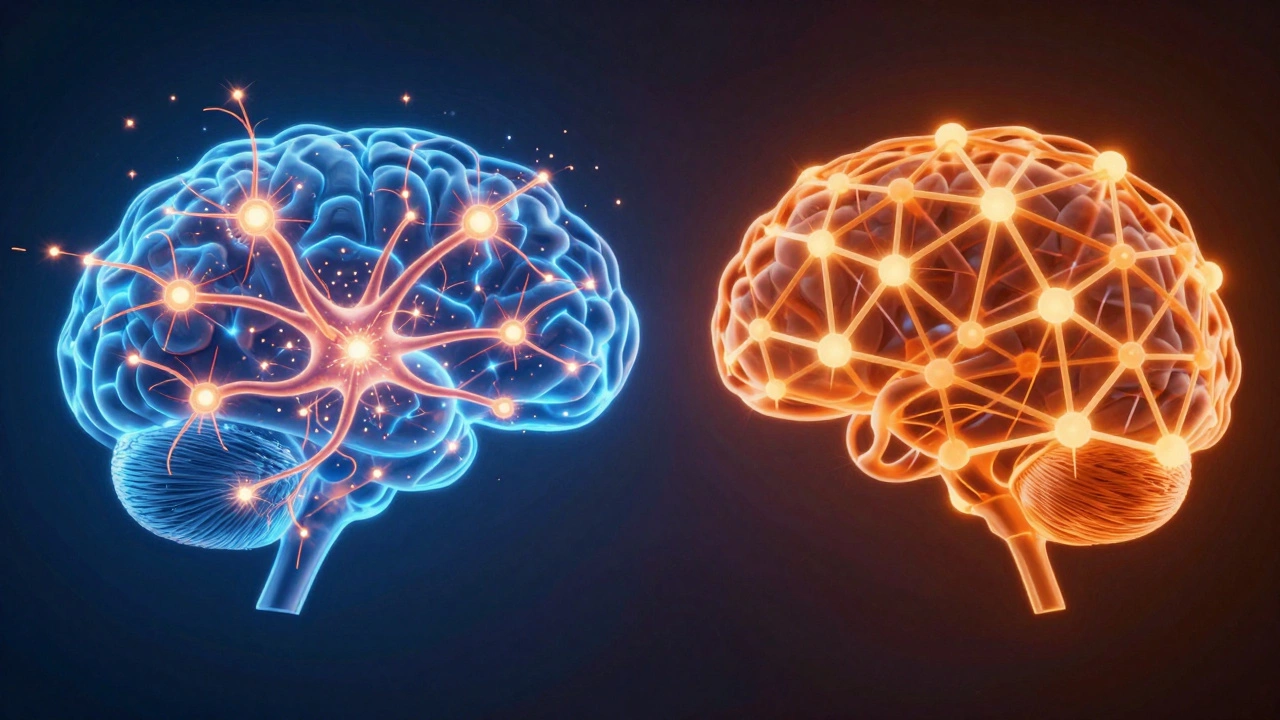
To understand why they are different, we have to look at what is actually happening in the brain. Think of it like two different types of traffic jams. In one, the roads are built differently. In the other, the drivers are having trouble following the rules of the road.
Autism Spectrum Disorder (ASD) is a neurodevelopmental condition characterized by differences in social communication, interaction, and restricted or repetitive patterns of behavior, interests, or activities. It affects how a person processes sensory information and navigates social norms. For many autistic people, the world feels loud, bright, and unpredictable. Their brains are wired to seek patterns and consistency to manage this chaos.
On the other hand, Attention-Deficit/Hyperactivity Disorder (ADHD) is a neurodevelopmental disorder marked by persistent patterns of inattention, hyperactivity, and impulsivity that interfere with functioning or development. The core issue here is regulation. Specifically, the regulation of attention, energy, and impulses. An ADHD brain doesn’t necessarily struggle with understanding social rules; it struggles with the executive function required to pause, plan, and execute those rules consistently.
So, while an autistic child might avoid eye contact because direct gaze feels physically painful or overwhelming, a child with ADHD might avoid eye contact because they are distracted by a bug on the window sill. The outcome looks similar from the outside, but the internal experience is completely different.
Why Do They Look So Similar?
If the roots are different, why do the branches look so alike? This is where the concept of phenotypic overlap comes in. Both conditions affect executive functions-the mental skills that help us get things done. When these skills are impaired, the external behaviors can mirror each other.
- Social Difficulties: Both groups may struggle in social settings. Autistic individuals might miss non-verbal cues due to processing differences. Individuals with ADHD might miss cues because they weren't paying attention to the conversation in the first place.
- Repetitive Behaviors: Autistic people often engage in stimming (self-stimulatory behavior) to regulate sensory input. People with ADHD might fidget or pace to stimulate a dopamine-starved brain. To an observer, both look like "repetitive movements," but the motivation differs.
- Emotional Dysregulation: Meltdowns happen in both conditions. For an autistic person, a meltdown is often a response to sensory overload or a change in routine. For someone with ADHD, it’s often a result of frustration from impulsivity or inability to transition tasks smoothly.
This overlap is dangerous if we stop looking there. If you treat the symptom without identifying the cause, the treatment fails. Giving medication for attention won’t fix sensory overload. Teaching social scripts won’t fix an inability to inhibit impulses.

The Reality of Co-Occurrence
Here is where it gets even more complex. While they are distinct, they love to hang out together. This is called comorbidity. In fact, recent data suggests that up to 30% to 50% of autistic people also meet the criteria for ADHD. Conversely, about 20% to 30% of people with ADHD have some level of autistic traits.
For a long time, the diagnostic manuals (like the DSM-5) didn’t allow clinicians to diagnose both at the same time. You had to pick one. This was a major flaw. It meant thousands of people were only getting half the picture. If a child was diagnosed with autism, their ADHD symptoms were dismissed as "just part of being autistic." If they were diagnosed with ADHD, their social struggles were ignored as "behavioral issues."
Now, we know better. A dual diagnosis changes everything. It means the support plan needs to address both the need for structure (autism) and the need for flexibility and stimulation (ADHD). It’s a balancing act, but it’s possible.
| Feature | ADHD | Autism (ASD) |
|---|---|---|
| Core Challenge | Regulation of attention and impulses | Social communication and sensory processing |
| Social Interaction | May interrupt or miss cues due to distraction | May miss cues due to difficulty interpreting non-verbal signals |
| Routine & Change | Struggles to maintain routines due to forgetfulness/boredom | Distressed by unexpected changes; seeks predictability |
| Sensory Issues | Often seeks sensory stimulation (touching, moving) | Can be over-sensitive (painful noise/light) or under-sensitive |
| Special Interests | Interests shift quickly based on novelty | Deep, intense, long-lasting focus on specific topics |
How Diagnosis Changes the Support Plan
Getting the right label matters because it dictates the tools you use. Let’s look at a classroom scenario. Imagine a student who can’t sit still.
If the student has ADHD, the teacher might provide a fidget toy, allow standing desks, or break tasks into smaller chunks to keep the brain engaged. The goal is to channel the excess energy and improve focus through novelty and movement.
If the student has autism, the same fidget toy might be too distracting. Instead, the student might need noise-canceling headphones to block out the hum of the lights, a visual schedule to reduce anxiety about what’s coming next, and clear, literal instructions. The goal is to reduce sensory load and increase predictability.
See the difference? One approach adds stimulation; the other removes it. If you mix them up, you could accidentally overwhelm the autistic child or bore the ADHD child to tears. This is why precise identification is crucial for special needs education.

Navigating the Gray Areas
Not every case fits neatly into a box. Some people have high-functioning autism with low ADHD symptoms. Others have severe ADHD with no autistic traits. And then there are those in the middle, where the lines blur.
In these cases, functional assessment is key. Instead of asking "Do they have trait X?", ask "What is causing the behavior?" Is the child rocking back and forth because they are anxious about a change in routine (autism), or because they are trying to self-soothe after a burst of hyperactivity (ADHD)? The answer guides the intervention.
It’s also important to remember that both conditions exist on spectrums. Severity varies wildly. Two people with the same diagnosis can have completely different experiences. This variability makes generalizations risky. Always look at the individual, not just the label.
What Parents and Educators Can Do
If you suspect either condition, or both, start with observation. Keep a log of behaviors. Note when they happen, what triggered them, and how the person responded. This data is gold for specialists.
Seek a comprehensive evaluation from a professional who understands both conditions. Many psychologists specialize in one or the other, but finding someone who can assess for co-occurrence is ideal. Don’t settle for a quick screening. A thorough assessment includes interviews, behavioral observations, and standardized tests.
Once you have a diagnosis, build a support network. Connect with other parents or adults who share your experience. Communities focused on neurodiversity offer practical tips that textbooks don’t. They can tell you which strategies work in real life, not just in theory.
Finally, advocate for accommodations. Whether it’s extra time on tests, a quiet workspace, or flexible deadlines, small adjustments can make a huge difference. The goal isn’t to "fix" the person. It’s to remove barriers so they can thrive in their own way.
Can a person have both ADHD and autism?
Yes, absolutely. This is known as comorbidity. Research shows that a significant percentage of people with autism also have ADHD, and vice versa. Having both means the individual faces challenges related to both attention regulation and social-sensory processing. Treatment plans must address both sets of needs simultaneously.
Is ADHD considered a developmental disability like autism?
Yes, ADHD is classified as a neurodevelopmental disorder, just like autism. Both begin in early childhood and affect how the brain develops and functions. While autism is often associated with more visible social and communication differences, ADHD primarily impacts executive functions like attention, impulse control, and organization. Both can significantly impact daily life and learning.
How do I tell if my child's social struggles are from ADHD or autism?
Look at the root cause. If your child misses social cues because they are distracted or impulsive (e.g., talking over others, not listening), it may lean toward ADHD. If they miss cues because they genuinely don't understand facial expressions, tone of voice, or unwritten social rules, it may lean toward autism. However, since overlap is common, a professional evaluation is necessary for an accurate distinction.
Does treating ADHD help autistic traits?
Treating ADHD symptoms, such as with medication or behavioral therapy, can improve focus and reduce impulsivity. This might make it easier for an autistic person to engage in social situations or learn new skills. However, it does not "cure" autism. Core autistic traits, such as sensory sensitivities or the need for routine, remain and require their own specific supports.
Are there genetic links between ADHD and autism?
Yes, genetics play a strong role in both conditions. Studies suggest that some of the same genes may influence the risk for both ADHD and autism, which explains why they often co-occur in families. However, the genetic pathways are complex and not identical, meaning one condition does not directly cause the other, but they share biological roots.