
UK GCSE to US GPA Converter
Enter your GCSE grades below to estimate your US GPA equivalent. Note that this is a general guide; official evaluations may vary by institution.
Estimated US Equivalence
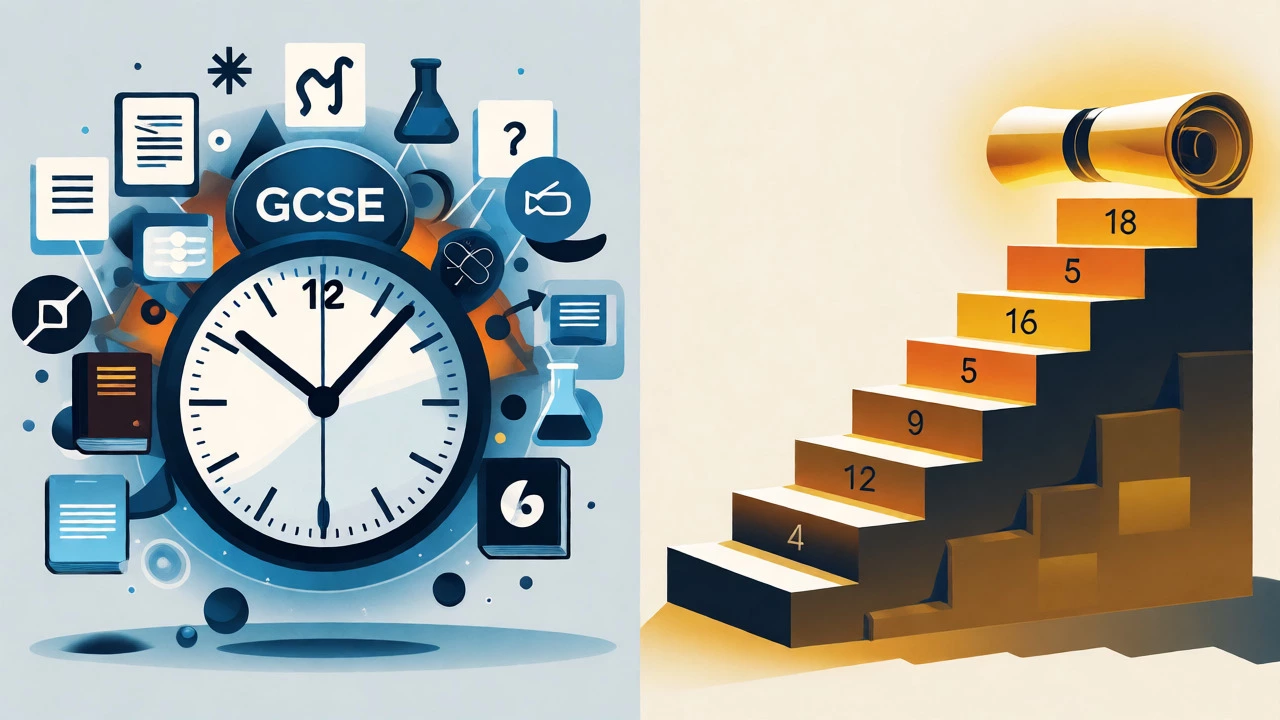
You’re staring at a transcript full of letters like A*, B, and C, and you’re wondering how this translates to the American system. It’s a common panic for students moving from the UK curriculum to the States, or for parents trying to understand where their child stands academically. The short answer? There isn’t one single "GCSE" in the USA. But there is a direct functional counterpart that colleges, employers, and visa officers look for: the High School Diploma. While GCSEs are subject-specific exams taken at age 16, the US system relies on a cumulative credit-based model that culminates in graduation at age 18.
Understanding this difference is crucial if you plan to apply to US universities or work in an American company. If you hand over a list of GCSE results without context, admissions officers might miss the rigor of your studies. They need to see the progression. Let’s break down exactly how these systems map onto each other, what grades translate to what GPA, and how to present your British qualifications so they make sense across the Atlantic.
The Core Difference: Subject Exams vs. Cumulative Credits
To grasp the equivalence, you have to look at how each system measures success. In England, Wales, and Northern Ireland, General Certificate of Secondary Education (GCSE) is a qualification awarded after completing secondary education. Students typically take between 8 and 10 subjects in Year 11 (age 15-16). Your grade is determined entirely by final external exams.
In contrast, the United States uses a state-regulated but locally administered system. There is no national exam at age 16. Instead, students earn credits for passing individual courses throughout four years of high school (grades 9 through 12). You graduate with a High School Diploma, which certifies you’ve completed the required number of credits in core subjects like English, Math, Science, and Social Studies.
| Feature | UK System (GCSE) | US System (High School) |
|---|---|---|
| Age Range | 14-16 years old (Years 10-11) | 14-18 years old (Grades 9-12) |
| Assessment Method | Final end-of-course examinations | Cumulative coursework, quizzes, midterms, finals |
| Outcome | Subject-specific certificates (e.g., GCSE Math) | Diploma certifying overall completion |
| Grading Scale | 9-1 numerical or A*-G letter grades | A-F letter grades converted to GPA (0.0-4.0) |
| Progression | Leads to A-Levels or Vocational Training | Leads directly to College/University entry |
This structural difference means that holding five good GCSEs doesn’t automatically equal a US High School Diploma. Why? Because the US diploma requires evidence of continuous study over four years. If you only have GCSEs, you are technically equivalent to a student who has completed Grade 10 (Sophomore year) in the US, not a high school graduate.
Mapping Grades: From 9-1 to GPA
If you are applying to US colleges, you will need to convert your grades into a Grade Point Average (GPA). Most US institutions use a 4.0 scale. Since the UK moved from the A*-G system to the 9-1 numerical system in recent years, many Americans are confused by the new numbers. Here is the general consensus used by credential evaluation services like WES (World Education Services) and NACES members:
- Grade 9 / A*: Equivalent to an A+ or 4.0 GPA. This indicates exceptional mastery.
- Grade 8 / A: Equivalent to an A or 3.7-4.0 GPA.
- Grade 7 / B: Equivalent to an A- or B+ (3.3-3.7 GPA).
- Grade 6 / B: Equivalent to a B (3.0 GPA). This is often considered a "good" pass.
- Grade 5 / C: Equivalent to a B- or C+ (2.3-2.7 GPA). This meets minimum standards for many jobs but may be weak for competitive universities.
- Grade 4 / C: Equivalent to a C (2.0 GPA). This is the traditional "pass" threshold in the UK.
- Grade 3 / D: Equivalent to a D (1.0 GPA). Passing, but rarely accepted for university entry.
- Grade 1-2 / E-G: Equivalent to F or failing grades in the US context, though technically a pass in the UK.
Keep in mind that US colleges care heavily about the trend. Did your grades improve from Year 10 to Year 11? Do you have strong grades in subjects relevant to your intended major? A straight set of 7s (Bs) looks very different from a mix of 9s and 4s depending on whether those 9s are in Math and Physics or in Drama and Art.
What Comes After GCSEs? The A-Level Connection
Here is the trap many students fall into: thinking GCSEs alone qualify them for US university. They don’t. In the UK, you move from GCSEs to A-Levels (Advanced Level qualifications) in Years 12 and 13. In the US, you stay in high school until age 18.
Therefore, the true academic equivalent of a completed UK secondary education pathway is actually the combination of GCSEs plus A-Levels. When US admissions officers review a British application, they want to see both.
- GCSEs show breadth. They prove you can handle a wide range of subjects at a foundational level.
- A-Levels show depth. They prove you can specialize and handle university-level complexity.
If you only have GCSEs, you are comparable to a US student who has finished their sophomore year. To get into a decent US college, you generally need to complete two more years of rigorous study-either via A-Levels, the International Baccalaureate (IB), or by entering the US high school system for grades 11 and 12.
Navigating the Transfer Process
If you are moving from the UK to the US mid-stream, here is how schools usually handle the paperwork. Don’t assume the registrar knows what a "Triple Award Science" is. You need to advocate for yourself.
- Gather Official Transcripts: Get sealed copies of your GCSE results from your school or examination board (like AQA, Edexcel, or OCR). Digital screenshots often aren’t enough.
- Get a Credential Evaluation: For serious applications (college or employment), use a service like World Education Services (WES) or Educational Credential Evaluators (ECE). They provide an official document stating, "This student holds a UK General Certificate of Secondary Education," and map it to the US framework.
- Explain the Curriculum: Include a syllabus summary if possible. Show that your GCSE Math covered algebra, geometry, and statistics. US teachers might assume a generic "Math" course was less advanced than it actually was.
- Plan for SAT/ACT: Even with great GCSEs, most US colleges require standardized tests like the SAT or ACT unless they are test-optional. Your GCSE grades don’t replace these scores.
One specific pitfall: some US private schools offer "International Baccalaureate" or "AP" classes that mimic the difficulty of A-Levels. If you have GCSEs, you might be placed into honors or AP classes rather than standard tracks, depending on the strength of your grades. Ask for a placement test if you feel under-challenged.
Employment Implications
Does a GCSE matter to a US employer? Generally, no. US job postings ask for a "High School Diploma or GED." If you stop schooling after GCSEs, you technically do not meet this requirement because you haven’t graduated high school in the American sense.
However, if you have strong vocational skills, you might bypass this. Trades like plumbing, electrical work, or coding bootcamps often value practical portfolios over diplomas. But for office jobs, retail management, or administrative roles, HR departments often filter out candidates without a verified high school completion certificate.
If you find yourself stuck in this limbo, consider taking the GED (General Educational Development) test in the US. It is a high school equivalency exam. Passing it gives you a certificate recognized as equivalent to a US High School Diploma. It’s a fast track for adults or international students who didn’t finish the full four-year US cycle.
Frequently Asked Questions
Is a GCSE equivalent to a US High School Diploma?
No, not directly. GCSEs are taken at age 16, whereas a US High School Diploma is awarded at age 18 after four years of study. GCSEs are roughly equivalent to completing the 10th grade (Sophomore year) in the US system. To achieve diploma equivalence, you typically need GCSEs plus two additional years of post-16 education, such as A-Levels or IB.
How do I convert my GCSE grades to US GPA?
There is no perfect formula, but credential evaluators generally map Grade 9/A* to a 4.0 GPA, Grade 7/B to a 3.3-3.7 GPA, and Grade 4/C to a 2.0 GPA. Always check with the specific institution or evaluation service (like WES) for their exact conversion table, as policies vary slightly between organizations.
Can I go to college in the USA with only GCSEs?
It is difficult. Most four-year universities require proof of high school graduation. With only GCSEs, you would likely need to attend a community college first for two years (an Associate Degree path) or complete your A-Levels before applying to a four-year institution. Some liberal arts colleges might consider you with strong extracurriculars, but it’s risky.
What is the GED and should I take it?
The GED is a US test that certifies high school equivalency. If you have GCSEs but never finished high school in the US or UK (A-Levels), taking the GED allows you to legally claim you have a "high school diploma" for US employment and college applications. It covers Math, Reasoning Through Language Arts, Science, and Social Studies.
Do US employers respect GCSEs?
Most US employers do not know what a GCSE is. They look for a High School Diploma. If you list "GCSEs" on a resume, clarify it as "Secondary Education Completion (UK)" or attach a credential evaluation report. Without this context, recruiters may assume you dropped out early.