Distance Learning Equivalence Calculator
Assess whether your online study path matches the outcomes of a traditional degree. Adjust the factors below to see your estimated equivalence score.
1. Academic Legitimacy
2. Field & Assessment Fit
3. Social & Networking Effort
4. Self-Discipline & Tech Readiness
You’re staring at a syllabus for an online course and wondering if it actually holds water. Does a degree earned from your kitchen table carry the same weight as one earned in a lecture hall? The short answer is yes, but the "equivalence" isn't just about the diploma on the wall. It’s about how employers see you, how other schools treat your credits, and whether you’re getting the actual skills or just watching videos.
People often ask this question because they are worried about wasting time or money. They want to know if switching to remote study means stepping down in quality. In reality, distance learning has evolved far beyond mailing correspondence courses. Today, it mirrors many aspects of traditional education, sometimes even surpassing them in flexibility and accessibility. But there are gaps. Let’s break down exactly what distance learning matches up against, where it aligns perfectly, and where it diverges significantly.
The Academic Credential: Degrees and Credits
First, let’s tackle the biggest fear: legitimacy. If you earn a bachelor’s degree from a regionally accredited university via their online portal, that credential is legally and academically equivalent to a degree earned by attending classes on campus. The transcript usually doesn’t even say "online." It lists the same courses, the same professors (often), and the same grading standards.
However, equivalence gets tricky when you try to move between institutions. Credit transfer policies vary wildly. A community college might accept online credits from a state university without blinking, while a private liberal arts college might reject them based on internal policy rather than academic merit. This isn’t about the quality of the education; it’s about bureaucratic inertia. Always check the accreditation status first. Regional accreditation in the US, such as that provided by the New England Commission of Higher Education, is the gold standard. If your online program has this, your credits have high portability.
Think of it like currency exchange. A dollar is a dollar, but some places won’t take foreign coins. Your degree is the bill; the specific institution’s policy is the shopkeeper deciding if they’ll accept it.
The Learning Experience: Synchronous vs. Asynchronous
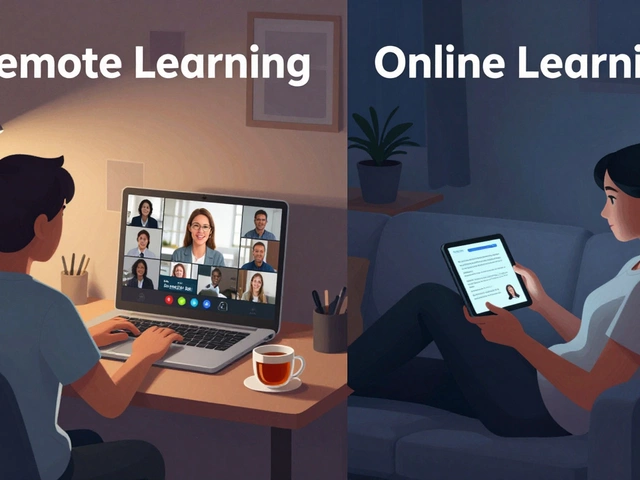
Traditional classrooms offer synchronous interaction-you show up at 10 AM, listen to a lecture, and ask questions immediately. Many people assume distance learning lacks this immediacy. That’s outdated thinking. Modern platforms support live video seminars, breakout rooms, and real-time chat features that mimic face-to-face discussion.
But here is the key distinction: asynchronous learning. This is where you watch recorded lectures and submit assignments on your own schedule. This format doesn’t replicate the social pressure of a classroom, which can be a double-edged sword. You lose the spontaneous hallway chats that often lead to networking opportunities. However, you gain deep work time. You can pause a complex engineering explanation, rewind it, and re-watch it three times before moving on. In a physical lecture, if you miss a detail, you’re out of luck until office hours.
So, what is it equivalent to? For self-motivated learners, asynchronous distance learning is equivalent to having a personal tutor who never gets tired of repeating themselves. For those who need external structure, it might feel less rigorous unless the instructor enforces strict deadlines.
Skill Acquisition and Assessment Methods
Employers care less about where you studied and more about what you can do. This is where distance learning shines in technical fields. Coding bootcamps, data science certificates, and digital marketing courses are inherently suited for remote delivery. The output-code repositories, marketing analytics reports, design portfolios-is digital anyway.
Assessment methods differ, though. Traditional exams rely heavily on proctored, in-person testing to prevent cheating. Online assessments use software like Honorlock or ProctorU, which monitor your webcam and screen activity. Some critics argue this creates anxiety. Others find it liberating compared to sitting in a silent gymnasium with hundreds of strangers.
Consider the practical application. If you are studying nursing, distance learning theory modules are equivalent to classroom lectures. But clinical hours must still happen in person. You cannot simulate patient care through a Zoom call. Here, distance learning acts as a complement to hands-on training, not a full replacement. The equivalence holds for knowledge acquisition, but breaks down for psychomotor skills.
Cost and Time Efficiency
Financially, distance learning is often cheaper, but not always. Tuition rates for online programs at major universities have started to match on-campus costs. However, you save massive amounts on housing, commuting, and meal plans. A student in Burlington, Vermont, taking an online class from a university in Boston saves thousands annually in travel and living expenses.
| Cost Factor | On-Campus Traditional | Distance Learning |
|---|---|---|
| Tuition | $10,000 - $50,000+ per year | $8,000 - $50,000+ per year |
| Housing/Food | $12,000 - $18,000 per year | $0 (if staying home) |
| Commuting | $1,000 - $3,000 per year | $0 - $500 (internet/electricity) |
| Total Estimated Annual Cost | $23,000 - $71,000 | $8,500 - $50,500 |
Time efficiency is another metric. Distance learning allows you to accelerate. If you master a module in two weeks instead of four, many programs allow you to move ahead. This competency-based approach means you pay for the credential, not the seat time. This makes distance learning equivalent to a fast-track career accelerator for working professionals.
Social Capital and Networking
This is the hardest area to equate. College isn’t just about books; it’s about the network you build. Dorm life, club meetings, and casual interactions create bonds. Online students often report feeling isolated. Without intentional effort, you miss out on the "weak ties" that often lead to job referrals.
To make distance learning equivalent in terms of networking, you have to work harder. Join virtual study groups. Attend optional live Q&A sessions. Use LinkedIn aggressively to connect with classmates and instructors. Some top-tier online programs now host regional meetups or annual conferences specifically to bridge this gap. If you treat the online platform as a social hub rather than just a content repository, you can replicate much of the traditional networking value.

Technology Requirements and Digital Literacy
Traditional schooling assumes basic literacy. Distance learning requires digital fluency. You need reliable internet, a decent computer, and the ability to troubleshoot minor tech issues. When your Wi-Fi drops during a final exam, you don’t have a professor walking by to help. You have to fix it yourself.
This adds a layer of responsibility that mirrors modern remote work environments. By navigating these challenges, you demonstrate soft skills valued by employers: adaptability, problem-solving, and self-management. In this sense, the struggle of distance learning is itself a form of professional development. It prepares you for a world where collaboration happens across time zones and screens.
Final Verdict: Where It Matches and Where It Doesn’t
Distance learning is fully equivalent to traditional education in terms of academic rigor, credential value, and theoretical knowledge transfer. It excels in cost-efficiency and flexibility. It falls short in spontaneous social interaction and hands-on physical skill practice unless supplemented by local labs or internships.
If you are disciplined, tech-savvy, and proactive about building connections, distance learning offers the same outcomes with fewer barriers. If you thrive on external structure and face-to-face mentorship, you may need to choose hybrid models carefully. The equivalence exists, but it requires active participation to unlock.
Do employers respect degrees from online universities?
Yes, especially if the institution is regionally accredited. Major companies like Google, Amazon, and IBM hire graduates from reputable online programs. The stigma has largely faded since 2020, as remote work became normalized. Employers focus more on skills and portfolio evidence than the mode of instruction.
Can I transfer credits from an online school to a traditional college?
It depends on the receiving institution's policy. Generally, credits from regionally accredited online programs are accepted. However, private colleges or highly selective universities may have stricter rules. Always request a pre-transfer evaluation before enrolling to ensure your credits will count toward your desired degree.
Is distance learning harder than traditional learning?
For many, yes, because it requires higher self-discipline. Without a fixed schedule, procrastination is easier. The material itself is usually identical, but the lack of immediate peer support and structured deadlines increases the cognitive load of managing your own progress.
Are lab sciences possible through distance learning?
Partially. Theory components are delivered online. Lab components often require either visiting a local partner site, using home experiment kits, or completing intensive weekend residencies. Fully remote biology or chemistry degrees are rare and often viewed differently than hybrid ones.
How does financial aid work for distance learners?
Eligible students can apply for federal financial aid (FAFSA) for online programs just like traditional ones. State grants may vary depending on residency requirements. Since you save on room and board, your total cost of attendance is lower, which can stretch your aid further.