
Special Needs vs. Neurodivergent Interactive Guide
Explore the Relationship
Select a condition to see how it fits into the Special Needs and Neurodivergent frameworks.
Needs
Divergent
Autism Spectrum Disorder
Classification: Neurodivergent & Special Needs
Autism is a classic example of neurodivergence (brain wiring difference). It often qualifies for special needs services due to sensory or social communication barriers requiring accommodation.
You walk into a classroom or a doctor’s office, and you hear two terms thrown around like they mean the same thing: special needs and neurodivergent. People use them interchangeably. Parents swap them in conversations about their kids. Teachers might even mix them up on paperwork. But here is the kicker: they are not synonyms. Treating them as identical can lead to bad advice, wrong resources, and a misunderstanding of what a person actually needs.
If you have ever paused mid-sentence wondering, "Wait, does having special needs make someone neurodivergent?" you are not alone. The short answer is no, not always. The long answer requires us to unpack how we define brain differences, where medical labels fit, and why this distinction matters for support and identity.
The Core Definitions
To see if one fits inside the other, we first need to know what each box holds. Let's start with Neurodivergence is a concept that describes natural variations in the human brain regarding sociability, learning, attention, mood, and other mental functions. It is not a disease; it is a difference. The term was coined by sociologist Judy Singer in the late 1990s. It challenges the idea that there is only one "right" way to think. If your brain works differently from the statistical majority, you are neurodivergent. This includes conditions like Autism Spectrum Disorder (ASD), Attention Deficit Hyperactivity Disorder (ADHD), Dyslexia, and Tourette Syndrome.
On the flip side, Special Needs is a broad umbrella term used primarily in education and healthcare systems. It refers to individuals who require additional support due to physical, developmental, behavioral, or emotional conditions. Think of "special needs" as a logistical label. It tells schools, insurers, and doctors, "This person needs extra help." It is functional. It focuses on barriers and accommodations.
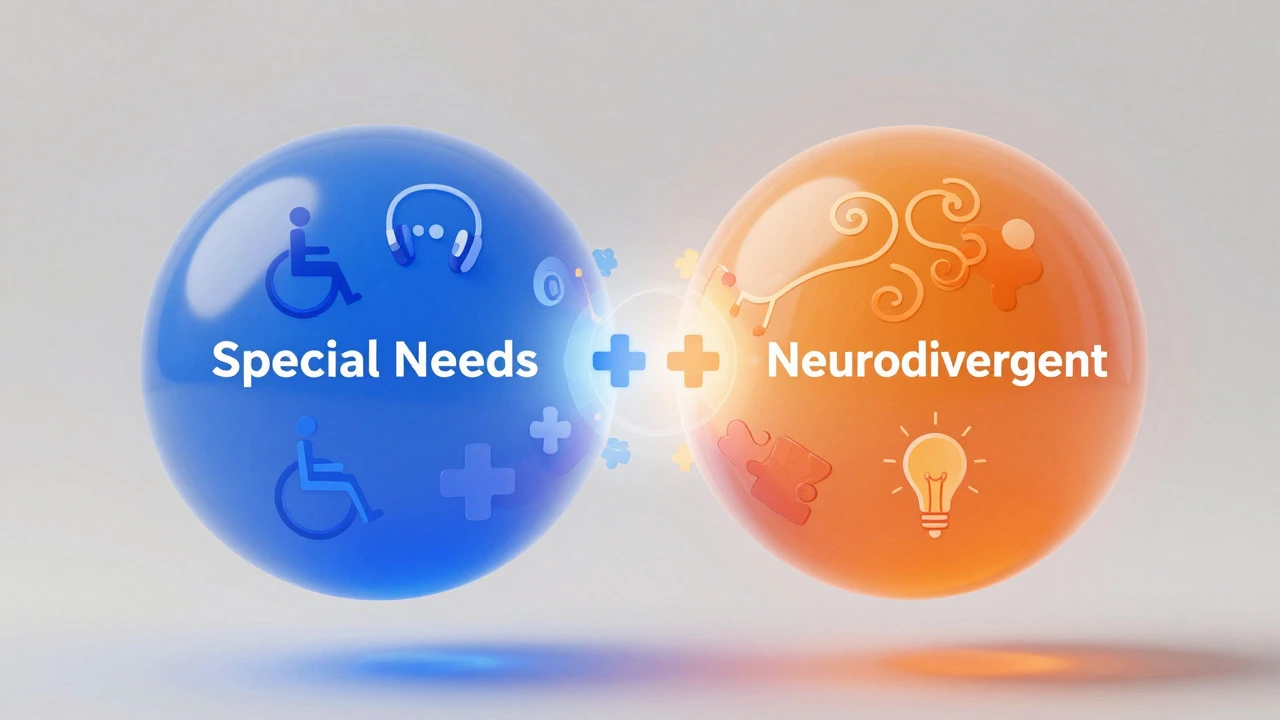
Here is where the Venn diagram gets interesting. All neurodivergent people might eventually fall under the "special needs" category if they require specific educational or medical support. However, not all people with special needs are neurodivergent. A child born with cerebral palsy has special needs because they may need physical therapy and adaptive equipment. Their brain structure regarding social processing or attention might be perfectly typical. They are physically disabled, but not necessarily neurodivergent.
Where the Lines Blur
Why do so many people confuse these terms? Because the overlap is massive. Many conditions sit squarely in both categories. Take Autism, which is characterized by differences in social communication, sensory processing, and repetitive behaviors. Autistic individuals are neurodivergent by definition. They also frequently qualify for special needs services because standard classrooms or workplaces may not accommodate their sensory sensitivities or communication styles without adjustments.
Consider ADHD. A student with ADHD struggles to focus in a lecture-heavy environment. That is a neurodivergent trait. To succeed, they might need an Individualized Education Program (IEP) or 504 plan. Those plans are tools for students with special needs. So, in this case, being neurodivergent leads to having special needs status. But remember, the cause is different. One is about brain wiring; the other is about required support.
Now look at the reverse. Imagine a student with Down syndrome. Down syndrome is a genetic condition affecting development. These students often have intellectual disabilities and health issues requiring specialized care. They definitely have special needs. Are they neurodivergent? The neurodiversity movement generally argues yes, because their cognitive processing differs from the norm. However, some strict definitions reserve "neurodivergent" for conditions like ASD and ADHD, excluding intellectual disabilities caused by chromosomal differences. This is where community debates happen. For now, most inclusive educators consider any significant deviation from typical neurological development as falling within the broader neurodiversity spectrum.
Medical Model vs. Social Model
The confusion often stems from clashing philosophies. The Medical Model views disability and difference as problems inherent to the individual that need to be cured or fixed. This model gave us the term "special needs." It asks, "What is wrong with this person? How do we treat it?"
The Social Model argues that people are disabled by society's failure to accommodate them, not by their bodies or brains. This aligns more closely with neurodiversity. It asks, "What barriers exist in the environment? How do we change the system?" When you ask if special needs equals neurodivergent, you are essentially asking which model you prefer. If you view a dyslexic reader as "broken," you lean toward special needs/medical. If you view them as a thinker who needs text-to-speech software, you lean toward neurodivergent/social.
Language shapes policy. If a school labels a child "special needs," they might focus on remediation-trying to make the child act "normal." If they label the child "neurodivergent," they might focus on strengths-based approaches, leveraging unique problem-solving skills. The outcome for the child changes based on the label, even if the underlying biology hasn't changed.
Common Misconceptions
Let's bust a few myths that trip people up.
- Myth: Neurodivergent means high IQ. Some people assume neurodivergent folks are all geniuses or savants. Not true. You can have average, below-average, or above-average intelligence while being autistic or having ADHD. Special needs classifications often rely on IQ scores, which can mislead parents into thinking a low score means no potential, or a high score means no struggle.
- Myth: Special needs is permanent. Many children outgrow certain speech delays or temporary learning hurdles. They had special needs at age six but not at age twelve. Neurodivergence, however, is typically lifelong. You don't "cure" ADHD; you manage it. You don't "fix" autism; you adapt to it.
- Myth: Physical disabilities are never neurodivergent. While cerebral palsy is primarily motor, many individuals with physical disabilities also have co-occurring neurodivergent traits. Co-morbidity is common. Having a wheelchair doesn't rule out having autism, and vice versa.
Why the Distinction Matters for Support
If you are a parent, teacher, or employer, getting this right saves time and money. If you approach a neurodivergent employee solely through a "special needs" lens, you might offer pity rather than productivity. You might lower expectations instead of adjusting workflows.
For example, a manager sees an employee struggling with open-office noise. If the label is "special needs," the solution might be a quiet room away from everyone else, isolating the worker. If the label is "neurodivergent," the solution might be noise-canceling headphones and flexible hours, keeping the worker integrated but supported. The first approach segregates; the second accommodates.
In education, the difference affects IEP goals. A "special needs" goal might be "Student will improve reading fluency to grade level." A "neurodivergent-affirming" goal might be "Student will use audiobooks to access curriculum content." Both address the reading challenge, but one forces compliance with a norm, while the other provides access through alternative means.

Comparison Table: Special Needs vs. Neurodivergent
| Feature | Special Needs | Neurodivergent |
|---|---|---|
| Primary Focus | Support requirements and deficits | Brain differences and diversity |
| Origin of Term | Medical/Educational systems | Sociological/Cultural movements |
| View of Condition | Something to fix or manage | A natural variation to respect |
| Scope | Broad (includes physical, sensory, intellectual) | Narrower (focuses on cognitive/neurological variations) |
| Goal of Intervention | Normalization or independence | Accommodation and inclusion |
How to Use These Terms Respectfully
Language evolves fast. What felt polite ten years ago might feel outdated today. Here is a practical guide for navigating this terrain.
First, follow the individual's preference. Some adults love the term "neurodivergent" because it feels empowering. Others prefer "person with special needs" because it connects them to necessary services and funding. There is no universal correct choice. Ask them.
Second, be precise. Don't say "He is special needs." That turns a condition into an identity noun. Say "He receives special education services" or "He has ADHD." Specificity reduces stigma. If you are discussing policy, use "special needs" when talking about funding and legal rights. Use "neurodivergent" when talking about culture, workplace inclusion, and social acceptance.
Third, recognize the hierarchy of needs. Before someone can embrace their neurodivergent identity, they often need their basic special needs met. Accessible ramps, medication coverage, and assistive technology come first. Once those logistical boxes are checked, the conversation can shift to identity and pride. You cannot celebrate neurodiversity if the bathroom is inaccessible.
The Future of Terminology
We are moving toward a world where "neurodivergent" becomes as common as "left-handed." Just as we stopped calling left-handedness a disorder, we are stopping viewing different brains as broken. Meanwhile, "special needs" remains crucial for legal protection. Laws like the Individuals with Disabilities Education Act (IDEA) in the US use specific language to guarantee rights. We aren't ditching "special needs" anytime soon because it carries legal weight.
The best approach is dual literacy. Understand that a person can be both. They can have special needs for legal purposes and be neurodivergent for cultural identity. Holding both truths simultaneously allows for better support and deeper respect.
Can a person have special needs without being neurodivergent?
Yes. Conditions like cerebral palsy, blindness, or hearing loss are classified as special needs because they require specific accommodations. However, they are primarily physical or sensory disabilities, not necessarily variations in neurological processing like autism or ADHD. Therefore, a person can have special needs without identifying as neurodivergent.
Is dyslexia considered a special need or neurodivergence?
It is both. Dyslexia is a classic example of neurodivergence because it represents a different way of processing language and visual information. Simultaneously, it is a special need in educational contexts because students often require specific interventions, such as phonics-based instruction or extra time on tests, to access the curriculum effectively.
Which term is less stigmatizing?
Generally, "neurodivergent" is viewed as less stigmatizing because it frames differences as neutral variations rather than deficits. "Special needs" can imply dependency or lack of ability. However, context matters. In legal and medical settings, "special needs" is the recognized terminology for accessing services, so using it there is not stigmatizing but rather practical.
Do all autistic people identify as neurodivergent?
No. While the neurodiversity paradigm originated largely within the autistic community, not every autistic person adopts the label. Some prefer medical models or simply describe themselves as autistic without political or sociological framing. Identity is personal, and respecting individual choice is key.
How does this affect workplace hiring?
Companies focusing on "special needs" might look for candidates who need reduced hours or simple tasks. Companies embracing "neurodivergence" actively seek out unique strengths, such as pattern recognition in autistic coders or hyper-focus in employees with ADHD. The latter approach often leads to higher retention and innovation.